
The Golden Retriever Shedding Cycle: When They Blow Coat and How Long It Lasts
We earn a commission if you buy through links in this post, at no extra cost to you.
About the health information here: it comes from vet groups and vet schools, but we’re dog owners, not vets, so for anything about your own dog’s health, check with your vet.
The short answer: Goldens shed moderately all year and blow their undercoat once or twice a year, usually in spring and fall, when daylight and temperature change. A coat blow usually lasts a few weeks to a couple of months. Puppies, intact females, spayed dogs and indoor dogs can all run on their own timing.
In this guide
- When do golden retrievers shed the most?
- What sets off a coat blow?
- What’s happening inside the coat during a blow?
- How long does a golden’s coat blow last?
- Is a spring coat blow different from a fall one?
- Do indoor goldens shed all year?
- When do golden retriever puppies lose their puppy coat?
- Do spayed or neutered goldens shed differently?
- Do intact female goldens shed with their heat cycle?
- Can stress or illness throw off the shedding cycle?
- What does a golden’s shedding year look like, month by month?
- FAQs
- Bottom line
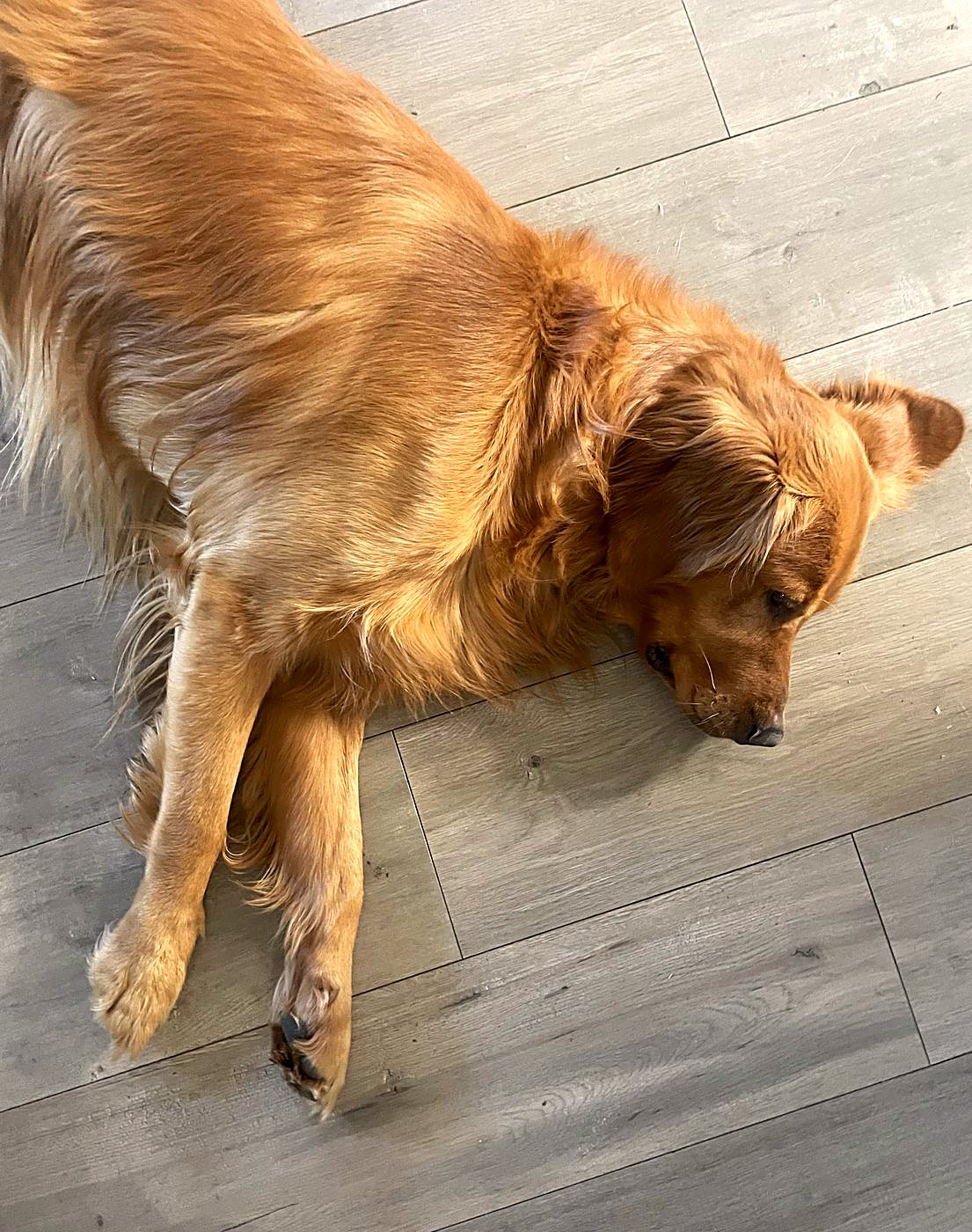
When do golden retrievers shed the most?
In spring and fall. The AKC says a golden’s double coat “sheds moderately throughout the year and heavily once or twice a year.” Those heavy stretches are what owners call blowing coat.
The Merck Veterinary Manual says most animals shed in early spring and early autumn. So if your golden suddenly starts leaving drifts of fluff in March or September, the calendar is probably the reason.
Some goldens have one big shed a year and some have two. Both are normal. In between, you’ll still see a steady trickle of hair, because the AKC lists thick double-coated breeds like goldens among the dogs more likely to shed year-round.
This post is about the timing. If you want the “make it stop” side (tools, shaving, fish oil, vacuums), that’s in how to stop golden retriever shedding (what you can and can’t change).
What sets off a coat blow?
Daylight and temperature. The AKC says shedding is mainly triggered by changes in both, and that the body’s hormonal response to those changes tells the coat it’s time to switch seasons.
Merck lists three things that control hair growth: nutrition, hormones and photoperiod (the length of the day). Temperature and day length are the seasonal ones. That’s why the big sheds come as the seasons turn, in early spring and early autumn, rather than in the hottest or coldest weeks.
Heat on its own can do it too. The Golden Retriever Club of Victoria says “excessive heat” can make a golden drop coat.
What’s happening inside the coat during a blow?
Every hair grows in a cycle. Vets break it into three phases:
-
Anagen: the hair is actively growing.
-
Catagen: a short in-between stage when growth stops.
-
Telogen: the hair is resting. It’s loose in the follicle and easy to pull out.
A veterinary dermatologist writing for dvm360 explains how the seasons move that cycle. In fall, as days get shorter and cooler, growth slows and the follicles hang on to their resting hairs, which builds the dense winter coat. In spring, as days get longer and warmer, the follicles wake up and new growing hairs push the old resting coat out. That push is the spring blow.
He also explains that neighboring follicles are always in different phases. That’s what keeps a dog from going bald when it sheds, and it’s why normal shedding comes out evenly all over instead of in patches.
Most of what you brush out is undercoat. The AKC says topcoat hairs shed less often, while the softer undercoat sheds more, especially in seasonal changes. One golden owner on r/goldenretrievers described the undercoat coming out “like cotton balls,” especially on her dog’s sides and flanks.
How long does a golden’s coat blow last?
The AKC says shedding season usually lasts a few weeks to a couple of months. It can take several weeks for a dog to fully drop its winter coat, and the shedding gets heavier than normal before it gradually tapers off.
The exact length depends on the dog, its coat and its surroundings. So a golden who blows hard for three weeks and one who sheds heavily for two months are both inside the normal range.
The best way to learn your own golden’s rhythm is to write it down. Note the date you first see clumps, and the date the brush comes away light again. After a year or two, you’ll know your dog’s months instead of guessing.
Is a spring coat blow different from a fall one?
They’re doing opposite jobs. The AKC says in spring, dogs drop the heavier winter coat to stay cool, and in fall they shed lighter hair to make room for thicker insulation.
Merck describes the two coats. The warm-weather coat has shorter, thicker hairs and fewer secondary hairs (the fine undercoat type), which helps the dog lose heat. The cold-weather coat is often longer and finer, which holds heat in.
So the spring blow is the one that clears out the most undercoat. That matches the dvm360 description of a “profound spring shed.” The fall blow makes way for the winter coat that’s about to grow in.
Do indoor goldens shed all year?
Many do, more evenly. The AKC says some dogs shed lightly throughout the year, especially indoor dogs with steady exposure to artificial light and temperature. Many of them still get heavier seasonal sheds on top.
A University of Minnesota study backs that up. Researchers clipped indoor Labrador retrievers for surgery in every season and tracked the regrowth. Hair took 13.6 to 15.4 weeks to grow back to its old length, and the season made no real difference. More than 80% of the hairs were in the resting phase in all four seasons.
That’s Labs, not goldens, but the same idea applies. A golden who lives in a climate-controlled house with the lights on into the evening may get weaker seasonal signals than a dog who spends the day outside. Expect a flatter, steadier shed with blows that may be less sharp.
If you live south of the equator, the seasons flip, and so does the cycle. One owner in Australia posted in October that “it’s almost summer here” and that “You could build another dog out of how much he sheds.”
When do golden retriever puppies lose their puppy coat?
Usually between 4 and 6 months old. The AKC says it varies widely, and can start as early as 12 weeks or wait until about a year.
Puppies are born with a single coat of soft, fluffy fur. The AKC says it gives way to an adult coat that’s usually thicker and stiffer, and double-coated breeds grow two layers as they develop. Some long-haired breeds go through “the uglies,” a few months of looking ruffled, patchy or shaggy while the adult coat comes in.
This shed can catch first-time owners off guard. One owner on r/goldenretrievers wrote that their 8-month-old’s hair was coming out with a light tug and asked if something was wrong or if it was just shedding season. At that age, the puppy coat change is one likely reason. If you see bald spots or sore skin, though, that’s not the puppy coat. See your vet.
Do spayed or neutered goldens shed differently?
Some spayed females get a different coat. Researchers at the University of Zurich list the golden retriever among the breeds prone to coat changes after spaying. Affected dogs grow a lot more woolly hair and lose some color intensity, and the coat ends up looking like a young dog’s. It’s called “puppy coat.”
It doesn’t happen to every dog. In their study of 15 females of different breeds, followed for a year after spaying, 20% developed coat changes. The researchers also found that spaying shifted the hair cycle, with more follicles growing and fewer resting.
A woolly coat holds on to loose undercoat, so it may need more line brushing to keep it from matting. That’s covered step by step in how often should you brush a golden retriever? (and how to do it right). The same researchers tested a hormone treatment that improved the coat in many of the dogs, so if the change bothers you, ask your vet.
The study was on females. We didn’t find similar research on neutered males.
Do intact female goldens shed with their heat cycle?
Often, yes. The Golden Retriever Club of Victoria says a female “coming into season or after whelping a litter, will drop most of her coat and can look rather like a Labrador Retriever.” It adds that males drop coat too, “but maybe not as often.”
The AKC says most dogs have a heat cycle about every seven months. So an intact female’s big sheds may follow her cycle rather than the spring and fall calendar.
Litters do it as well. Merck says temporary hair loss can happen during pregnancy and nursing.
Can stress or illness throw off the shedding cycle?
Yes, in two different ways.
Fast stress shedding. VCA Animal Hospitals lists shedding as a sign of stress. It says nervous show dogs often “blow their coat” in the ring, and that dogs shed a lot at the vet clinic. That’s the cloud of hair on the exam table. It’s short-lived.
A delayed shed. Merck says temporary hair loss can show up several weeks after a severe illness or fever. A veterinary dermatologist writing in the WSAVA congress proceedings calls this telogen effluvium. Stress, illness or poor nutrition can push many hairs into the resting phase at once, and the shedding appears a few months after the event. He says it generally resolves on its own once the cause is gone.
So if your golden sheds hard in July, think back a couple of months. A surgery, a high fever or a stressful move could be the trigger.
Some shedding isn’t the cycle at all. Merck says hypothyroidism can cause dryness, excessive shedding and slow regrowth, and it lists goldens among the breeds most prone to it. Bald patches, red or scaly skin, constant scratching, or thinning on both sides of the body need your vet. The full list of warning signs is in how to stop golden retriever shedding (what you can and can’t change), and the conditions goldens are prone to are in golden retriever health issues: what to watch for (and when to call the vet).
What does a golden’s shedding year look like, month by month?
Here’s a plan we put together from the timing and brushing guidance above. The months are typical windows for the Northern Hemisphere, not fixed dates, and your golden may blow once a year or twice.
| Months | What’s likely happening | What to do |
|---|---|---|
| December to February | Winter coat is in. Moderate, steady shedding | Brush at least once a week. Comb two to three times a week to prevent mats |
| March to May | Spring blow window. New hair pushes out the winter undercoat. Often the heaviest shed of the year | Brush every day once clumps appear. Add an undercoat rake. A bath can help loosen hair (brush first) |
| June to August | Lighter summer coat. Shedding settles. Heat waves can still bring a drop | Back to weekly brushing. Don’t shave (it doesn’t stop shedding) |
| September to November | Fall blow window. Lighter hair comes out to make room for winter insulation | Brush daily again while it lasts, with the rake |
| Any month | Puppy coat change (about 4 to 6 months), after a heat or a litter, a few months after illness or stress | Brush more while it lasts. Bald spots or sore skin mean a vet visit |
The brushing numbers come from the AKC. Its golden guide says to brush once a week in normal shedding and daily in heavy shedding. Its shedding guide suggests switching to a coat rake or deshedding tool in heavy periods to pull out loose undercoat, and its double-coat guide suggests combing two to three times a week to prevent mats. The AKC also says golden home companions benefit from a monthly bath, and to always brush before bathing.
An undercoat rake for blow weeks: the Safari Double Row Undercoat Rake with Rotating Pins. The maker designs it for long hair and thick, heavy coats, and it comes in one Medium/Large size (a research-based pick that fits a golden, not one we’ve tested):
Check price on AmazonCheck price on Chewy
FAQs
Do golden retrievers shed more in summer or winter?
Neither, mostly. The big sheds come in spring and fall, when daylight and temperature are changing. Summer and winter are the steadier stretches in between.
When does golden retriever shedding season start?
Merck says most animals shed in early spring and early autumn. For many goldens in the Northern Hemisphere, that means watching for clumps from about March and again from about September.
Do male or female goldens shed more?
Intact females often have extra sheds. The Golden Retriever Club of Victoria says females drop most of their coat around a heat or after a litter, and males drop coat “maybe not as often.”
Is it normal for my golden to shed in winter?
Yes. Goldens shed moderately all year, and indoor dogs under steady light and heat often shed more evenly across the seasons.
What makes a golden shed out of season?
Common reasons are a puppy coat change, a heat cycle or litter, a stressful event, or an illness a few months back. If there are bald patches or skin changes, check with your vet.
Bottom line
Goldens shed a little all the time and a lot once or twice a year, usually in spring and fall, for a few weeks to a couple of months. Changing daylight and temperature run the cycle, but puppies, intact females, spayed dogs and indoor dogs can follow their own clock. Brush weekly most of the year, daily with a rake during a blow, and see your vet for bald spots or sore skin.
Get the free Golden Puppy 90-Day Plan: the before-day-one shopping list (grooming kit included), a daily schedule at 8, 10 and 12 weeks, and a week-by-week checklist for your first three months.
Keep reading: how to stop golden retriever shedding (what you can and can’t change) · how often should you brush a golden retriever? (and how to do it right) · golden retriever health issues: what to watch for (and when to call the vet)
Sources
-
American Kennel Club, “How to Groom a Golden Retriever” (shedding pattern, brushing frequency, monthly bath, brush before bathing): https://www.akc.org/expert-advice/health/how-to-groom-golden-retriever/
-
American Kennel Club, “Dog Shedding: What to Expect and How to Manage It” (spring and fall, triggers, duration, indoor dogs, rake in heavy shedding): https://www.akc.org/expert-advice/health/managing-dog-shedding/
-
American Kennel Club, “What Is a Double-Coated Dog? Coat Types, Grooming, and Care” (topcoat vs undercoat shedding, combing frequency): https://www.akc.org/expert-advice/dog-breeds/double-coated-dog-breeds/
-
American Kennel Club, “Why Do Puppies Shed Their Coat? What To Know About Puppy Fur”: https://www.akc.org/expert-advice/health/why-puppies-shed/
-
American Kennel Club, “How Often Do Dogs Go Into Heat? Everything You Need to Know”: https://www.akc.org/expert-advice/dog-breeding/dogs-in-heat/
-
Merck Veterinary Manual, “The Integumentary System in Animals” (hair cycle, what controls hair growth, seasonal shedding, warm and cold coats): https://www.merckvetmanual.com/integumentary-system/integumentary-system-introduction/the-integumentary-system-in-animals
-
Merck Veterinary Manual, “Hair Loss (Alopecia) in Dogs” (pregnancy, nursing, after illness or fever): https://www.merckvetmanual.com/dog-owners/skin-disorders-of-dogs/hair-loss-alopecia-in-dogs
-
Merck Veterinary Manual, “Hypothyroidism in Animals”: https://www.merckvetmanual.com/endocrine-system/the-thyroid-gland/hypothyroidism-in-animals
-
W.H. Miller Jr., VMD, DACVD, “Acquired alopecias mimicking endocrine skin disease (Parts 1 and 2) (Proceedings),” dvm360 (seasonal hair cycle, asynchronous growth): https://www.dvm360.com/view/acquired-alopecias-mimicking-endocrine-skin-disease-parts-1-and-2-proceedings
-
Masahiko Nagata, DVM, PhD, DAICVD, “Clinical Approach to Alopecia in Dogs,” WSAVA 2011 Congress proceedings, VIN (telogen effluvium): https://www.vin.com/apputil/content/defaultadv1.aspx?id=5124395&pid=11343&print=1
-
Diaz SF, Torres SM, Dunstan RW, Lekcharoensuk C, “An analysis of canine hair re-growth after clipping for a surgical procedure,” Veterinary Dermatology, 2004 (University of Minnesota): https://pubmed.ncbi.nlm.nih.gov/14989702/
-
Reichler IM et al., “Spaying-induced coat changes: the role of gonadotropins, GnRH and GnRH treatment on the hair cycle of female dogs,” Veterinary Dermatology, 2008 (University of Zurich): https://pubmed.ncbi.nlm.nih.gov/18336424/
-
Golden Retriever Club of Victoria, “Grooming” (coat drop in females, males and heat): https://grcv.org.au/Grooming/
-
VCA Animal Hospitals, “Signs Your Dog Is Stressed and How to Relieve It”: https://vcahospitals.com/know-your-pet/signs-your-dog-is-stressed-and-how-to-relieve-it
-
Coastal Pet, Safari Dog Double Row Undercoat Rake with Rotating Pins (maker specs): https://www.coastalpet.com/products/detail/?id=SRDRP
-
r/goldenretrievers, “Blowing their coat” (undercoat “like cotton balls”): https://redd.it/1v5t0pa
-
r/goldenretrievers, “Shedding Season – Good Boy Spam (Australia)”: https://redd.it/1odkegf
-
r/goldenretrievers, “My 8 mo Golden is loosing hair”: https://redd.it/1ptfc9x
