Golden Retriever Puppy Schedule: A Sample Day at 8, 10 and 12 Weeks
We earn a commission if you buy through links in this post, at no extra cost to you.
About the health information here: it comes from vet groups and vet schools, but we’re dog owners, not vets, so for anything about your own puppy’s health, check with your vet.
The short answer: At 8 to 12 weeks, a golden retriever puppy does well on four meals a day, a potty trip after every nap, meal, drink and play session, and 18 to 20 hours of sleep. Build the day as short awake windows that end in a nap, with a few minutes of training and one new experience mixed in.
In this guide
- What does a golden retriever puppy’s day need to include?
- How long can a golden puppy hold it?
- Sample schedule for an 8-week-old golden retriever puppy
- Sample schedule for a 10-week-old golden retriever puppy
- Sample schedule for a 12-week-old golden retriever puppy
- What should nights look like?
- If you work full time: what schedule works?
- How do you handle biting at 9 to 10 weeks?
- How much exercise does a golden puppy need?
- Where do vet visits and vaccines fit?
- How we built these schedules
- FAQs
- Bottom line
What does a golden retriever puppy’s day need to include?
Move the times around all you like, but keep these in:
-
Four meals. Four a day from 6 to 12 weeks, then three from 3 to 6 months. (Some schedule pages show three at 8 weeks. The AKC says four.)
-
Lots of potty trips. On waking, 5 to 30 minutes after meals, after drinking, during or after play, and any time the activity changes.
-
Lots of sleep. Puppies sleep 18 to 20 hours a day, often napping every hour or so for 30 minutes to two hours. Follow active time with quiet time.
-
Alone time. Give your puppy time to play alone with a favorite toy, like a stuffed food toy, or nap in a crate or pen.
-
Socialization. The first three months are the most important time for it, and it should start before vaccines are done. The sensitive window runs about 3 to 14 weeks, so 8 to 12 weeks sits right inside it. For a printable list of people, sounds, places and handling to try, see puppy socialization checklist for your golden (free printable).
-
Short training. Five to 10 minutes a session is plenty.
How long can a golden puppy hold it?
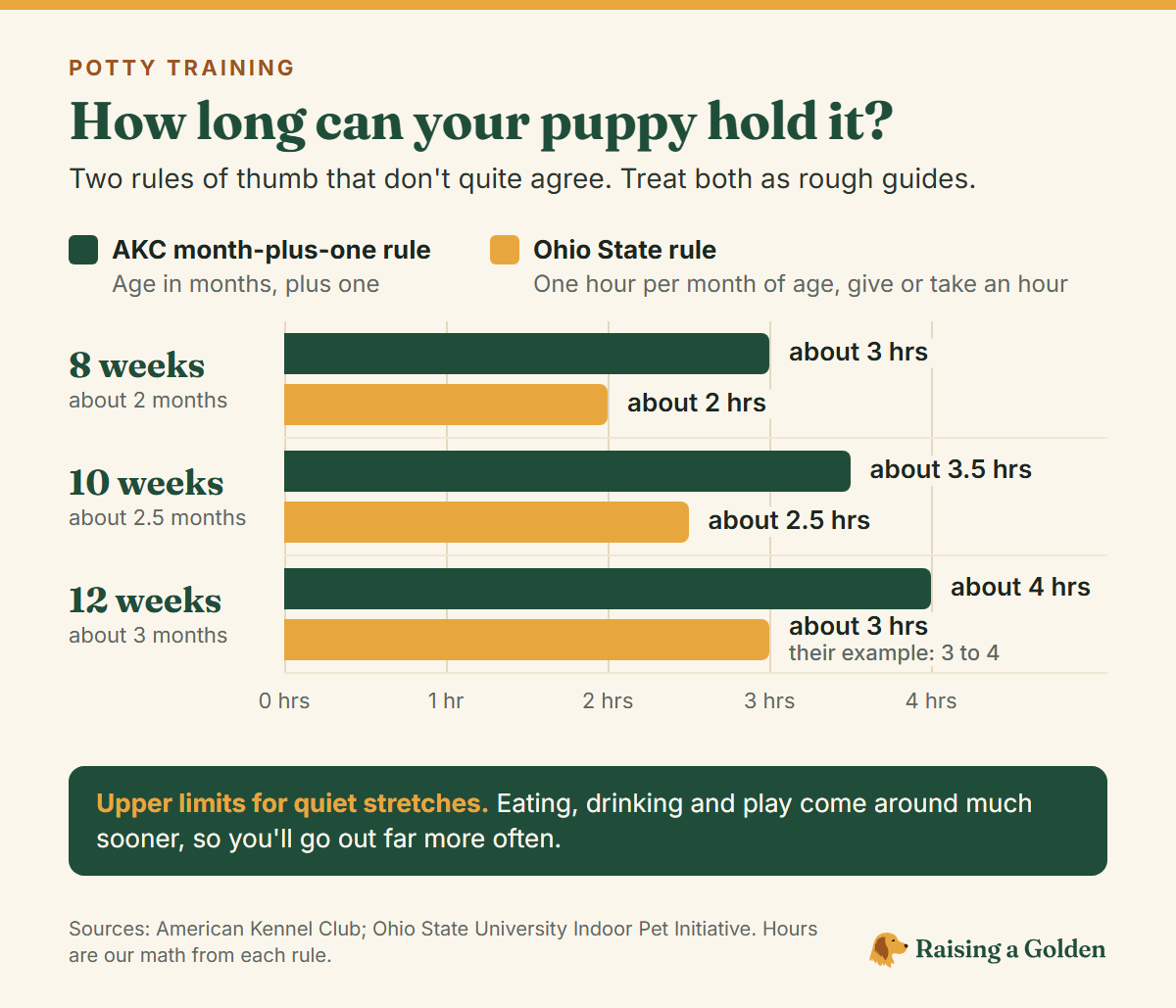
Only a few hours. The two best-known rules don’t quite agree, so treat both as rough guides:
-
The AKC’s month-plus-one rule: age in months plus one is the most hours your puppy should comfortably hold it.
-
Ohio State’s rule: one hour per month of age, give or take an hour. A 3-month-old might hold it 3 to 4 hours.
Here’s our math from each:
| Age | AKC rule | Ohio State rule |
|---|---|---|
| 8 weeks (about 2 months) | About 3 hours | About 2 hours |
| 10 weeks (about 2.5 months) | About 3.5 hours | About 2.5 hours |
| 12 weeks (about 3 months) | About 4 hours | About 3 hours (their example: 3 to 4) |
These are upper limits for quiet stretches. Eating, drinking and play come around much sooner, so you’ll go out far more often.
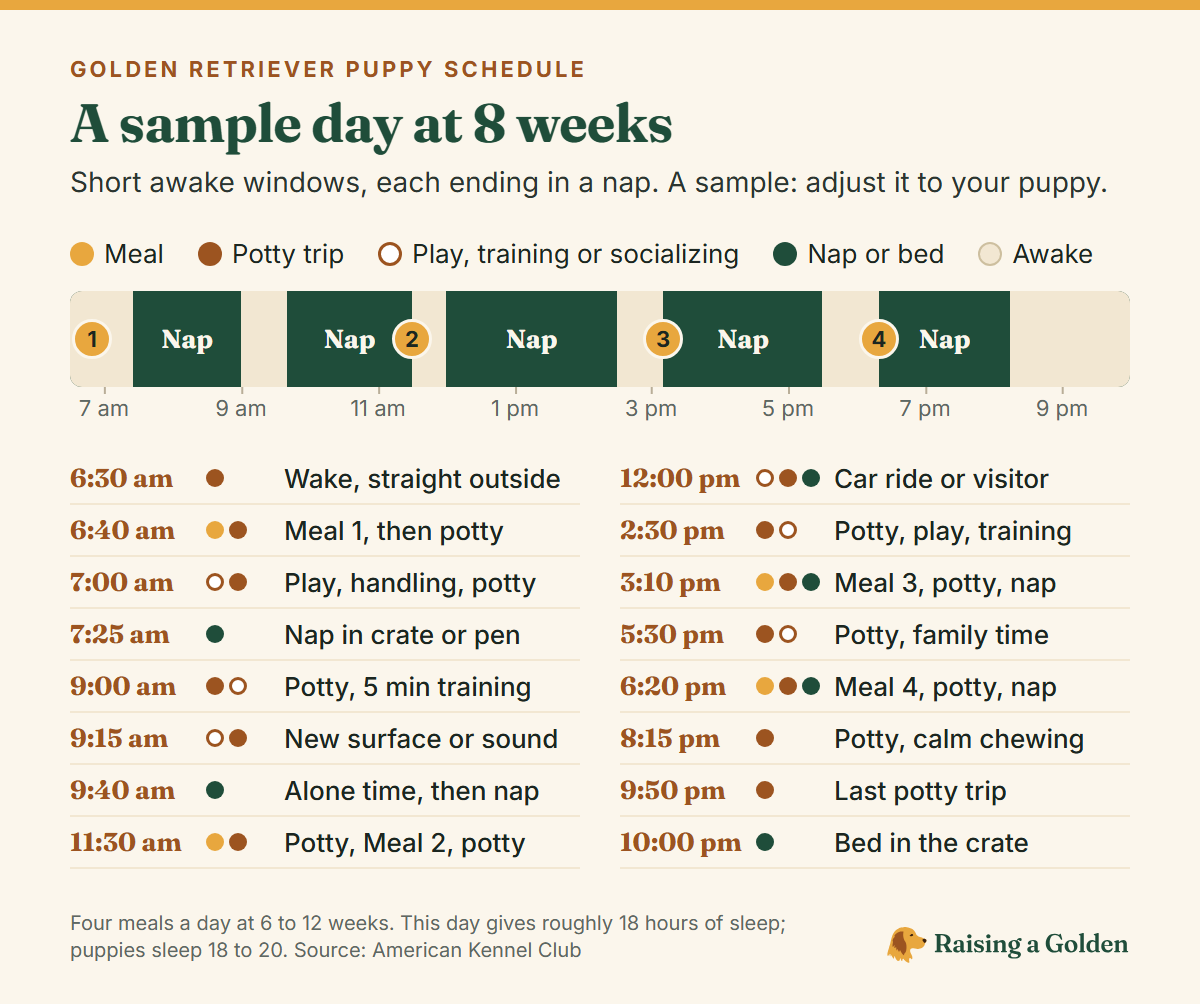
Sample schedule for an 8-week-old golden retriever puppy
Keep awake windows to about an hour or less. This is a sample day. Adjust it to your puppy, your vet’s advice and your own wake-up time.
| Time | What happens |
|---|---|
| 6:30 am | Wake up, carry your puppy straight outside |
| 6:40 am | Meal 1, potty trip 15 minutes later |
| 7:00 am | Play and gentle handling (paws, ears, mouth), then potty |
| 7:25 am | Nap in the crate or pen |
| 9:00 am | Wake, potty, 5 minutes of training (name, sit) |
| 9:15 am | Socialization at home: a new surface or a new sound, then potty |
| 9:40 am | Alone time in the pen with a stuffed chew toy, then nap |
| 11:30 am | Wake, potty, Meal 2, potty |
| 12:00 pm | Socialization: a short car ride or a calm visitor, then potty and nap |
| 2:30 pm | Wake, potty, play and 5 minutes of training |
| 3:10 pm | Meal 3, potty, nap |
| 5:30 pm | Wake, potty, family time and handling |
| 6:20 pm | Meal 4 (more than 2 hours before bed), potty, nap |
| 8:15 pm | Wake, potty, calm chewing, then quiet time in the pen |
| 9:50 pm | Last potty trip |
| 10:00 pm | Bed in the crate, in or near your bedroom |
That adds up to roughly 18 hours of sleep, the low end of the range. If your puppy wants more, let them have it.
Get the free Golden Puppy 90-Day Plan: this schedule as a printable page for 8, 10 and 12 weeks, the before-day-one shopping list, and a week-by-week checklist for your first three months.
Sample schedule for a 10-week-old golden retriever puppy
Same shape, slightly longer awake windows, a second socialization slot and some brain games. This is a sample day. Adjust it to your puppy.
| Time | What happens |
|---|---|
| 6:30 am | Wake up, straight outside |
| 6:40 am | Meal 1, potty |
| 7:00 am | Play, handling and a quick brush, 5 minutes of training, potty, nap |
| 9:30 am | Wake, potty, a sniffari (kibble tossed in the yard) or a food puzzle |
| 10:00 am | Socialization: a new surface, a new sound, or a calm dog you know is vaccinated (ask your vet first) |
| 10:30 am | Potty, alone time with a stuffed chew toy, nap |
| 12:00 pm | Wake, potty, Meal 2, potty |
| 12:30 pm | Socialization: a car ride, or sit outside and watch people go by, then potty and nap |
| 3:00 pm | Wake, potty, 5 minutes of training, tug with a toy |
| 3:30 pm | Meal 3, potty, nap |
| 5:30 pm | Wake, potty, family time |
| 6:30 pm | Meal 4, potty, nap |
| 8:30 pm | Wake, potty, calm chewing, quiet time in the pen |
| 9:50 pm | Last potty trip |
| 10:00 pm | Bed |
Good brain games at this age: food puzzles, trick training, hide-and-seek, tug, and a sniffari.
Sample schedule for a 12-week-old golden retriever puppy
Your puppy can stay up a bit longer now, and a puppy class can go in the evening if your vet agrees. This is a sample day. Adjust it to your puppy.
| Time | What happens |
|---|---|
| 6:30 am | Wake up, straight outside |
| 6:40 am | Meal 1, potty |
| 7:00 am | 5 to 10 minutes of training, play, potty, nap |
| 9:45 am | Wake, potty, socialization outing: a short car ride or a quiet spot to watch the world. Skip dog parks |
| 10:45 am | Potty, alone time with a stuffed chew toy, nap |
| 12:00 pm | Wake, potty, Meal 2, potty |
| 12:30 pm | Hide-and-seek or a sniffari, 5 minutes of training, potty, nap |
| 3:15 pm | Wake, potty, handling and a short brushing session |
| 3:45 pm | Meal 3, potty, nap |
| 5:30 pm | Wake, potty, family time and tug |
| 6:30 pm | Meal 4, potty |
| 7:00 pm | Puppy class (if your vet has cleared it) or calm play at home |
| 8:15 pm | Potty, nap or quiet time |
| 9:50 pm | Last potty trip |
| 10:00 pm | Bed |
Moving to three meals. When your vet says it’s time, keep breakfast and the evening meal and merge the two middle meals into one around 12:30.
Puppy class. Classes can start at 7 to 8 weeks, after a first deworming and at least one set of vaccines 7 or more days before class. Skip dog parks for now.
Grooming practice. Get your puppy used to the bath and dryer from about 7 weeks old. A few minutes of brushing is plenty.
What should nights look like?
One last potty trip right before bed, the crate in or near your bedroom, and a trip outside if your puppy wakes and whines. At 8 weeks the night is longer than either bladder rule, so expect to get up some nights.
-
Keep the crate close. You’ll hear a whimper if your puppy needs out. Puppies hold it longer while they’re asleep.
-
Carry them out. It stops a small puppy peeing on the floor on the way to the door.
-
Last meal. Skip food in the 2 hours before bed. Every sample here ends meals at least 3 hours before.
-
Water. We didn’t find a reputable source for a cutoff time. Ask your vet before you limit water.
-
Crying. Never force your puppy into the crate or leave them to cry it out. More in how to crate train a golden retriever puppy (including the first nights).
Crate pick that fits a golden: adult size, with a divider so it grows with your dog (we haven’t tested it ourselves). Sizing details are in golden retriever puppy checklist: what to buy before day one.
Check price on AmazonCheck price on Chewy
Accidents will happen. Don’t punish them. Rewarding the right spot and preventing mistakes works better, and an enzymatic cleaner gets rid of the odor (research-based pick, not one we’ve tested):
Check price on AmazonCheck price on Chewy
If you work full time: what schedule works?
A young golden can’t hold it through a workday under either bladder rule. Plan a midday break, and at 8 to 10 weeks, plan more than one.
-
A midday helper. A dog walker, sitter or neighbor lets your puppy out.
-
A pen, not a long crate stay. Never crate your puppy longer than they can hold it. Use a playpen or a gated kitchen with space to sleep and potty.
-
Daycare. Ask your vet first if the vaccine series isn’t done.
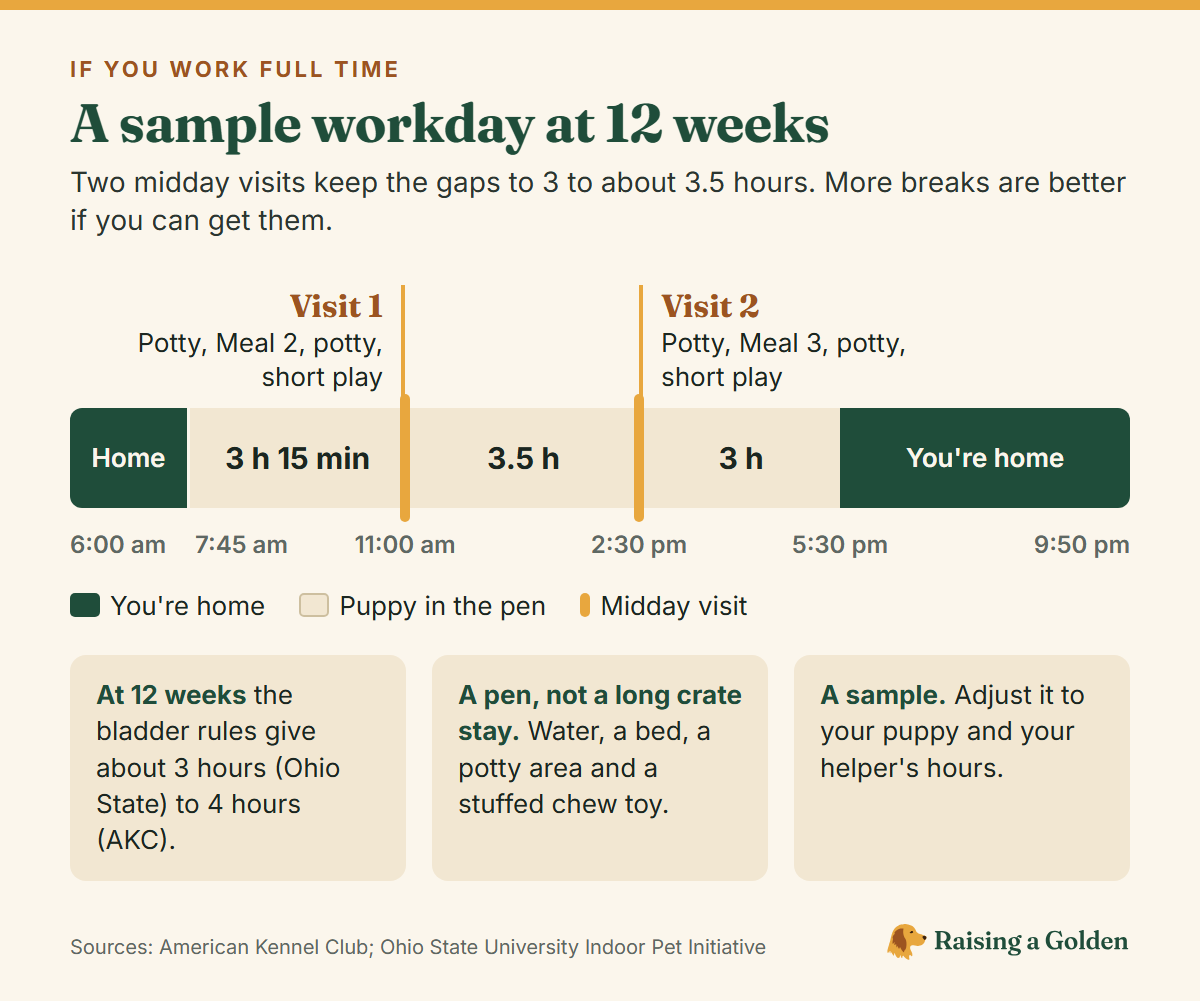
Here’s a sample workday at 12 weeks. Adjust it to your puppy and your helper’s hours.
| Time | What happens |
|---|---|
| 6:00 am | Wake, potty, Meal 1, potty |
| 6:30 am | Play, handling, 5 minutes of training, potty, nap |
| 7:45 am | Potty, then into the pen with water, a bed, a potty area and a stuffed chew toy |
| 11:00 am | Visit 1: potty, Meal 2, potty, short play |
| 2:30 pm | Visit 2: potty, Meal 3, potty, short play |
| 5:30 pm | You’re home: potty, play, a socialization slot |
| 6:30 pm | Meal 4, potty, then naps, training and calm time |
| 9:50 pm | Last potty trip, then bed |
Even with two visits, the gaps run 3 to about 3.5 hours. More breaks are better if you can get them.
How do you handle biting at 9 to 10 weeks?
Puppy biting is normal. The goal is to teach your puppy to control how hard they mouth.
-
Nap first. A biting puppy is often an overtired puppy. Every sample day ends each awake window in a nap, partly for this.
-
Game over. If teeth touch skin during play, playtime’s over. No exceptions.
-
Yelp, then step away. Try a high-pitched yelp and a limp hand. If that doesn’t work, get up and move away for 10 to 20 seconds.
-
Keep a toy handy, and play without hands. Fetch and tug, not wrestling.
-
Burn some energy. If biting keeps up after several toy swaps, your puppy may need more exercise, physical or mental.
-
Don’t hit. Slapping can make puppies bite harder.
Get a trainer’s help if it isn’t easing by 6 months. See a certified behaviorist or veterinary behaviorist sooner if you see a stiff or frozen body, lips pulled back or growling.
Chewing won’t end at 12 weeks. Adult incisors start coming in at about 3.5 to 4 months, and most dogs have all 42 adult teeth by 6 to 7 months.
A puppy chew toy that fits a golden (research-based pick, not one we’ve tested):
Check price on AmazonCheck price on Chewy
Full guide: golden retriever puppy biting: what’s normal and how to stop it.
How much exercise does a golden puppy need?
Nobody has a proven number. Ask your vet, and go easy on jumping, twisting and stairs.
-
The 5-minute rule. You’ll see it everywhere: about five minutes of walking per month of age, once or twice a day. The UK vet charity PDSA says there’s no scientific evidence behind it and it isn’t right for most puppies.
-
Large-breed limits. No jogging until 12 to 18 months, and no repeated jumping, like tossing a ball straight up or dock diving, which can hurt a puppy’s back.
-
The stairs study. A Norwegian study linked stairs from birth to 3 months with a higher risk of hip dysplasia, and off-leash exercise in those months with a lower risk. The authors suggest outdoor exercise on soft ground. It studied Labradors, Newfoundlands, Leonbergers and Irish Wolfhounds, not goldens, so treat it as a signal from other large breeds.
That’s the reason the samples lean on sniffing, food puzzles, tug and short training instead of long walks.
Where do vet visits and vaccines fit?
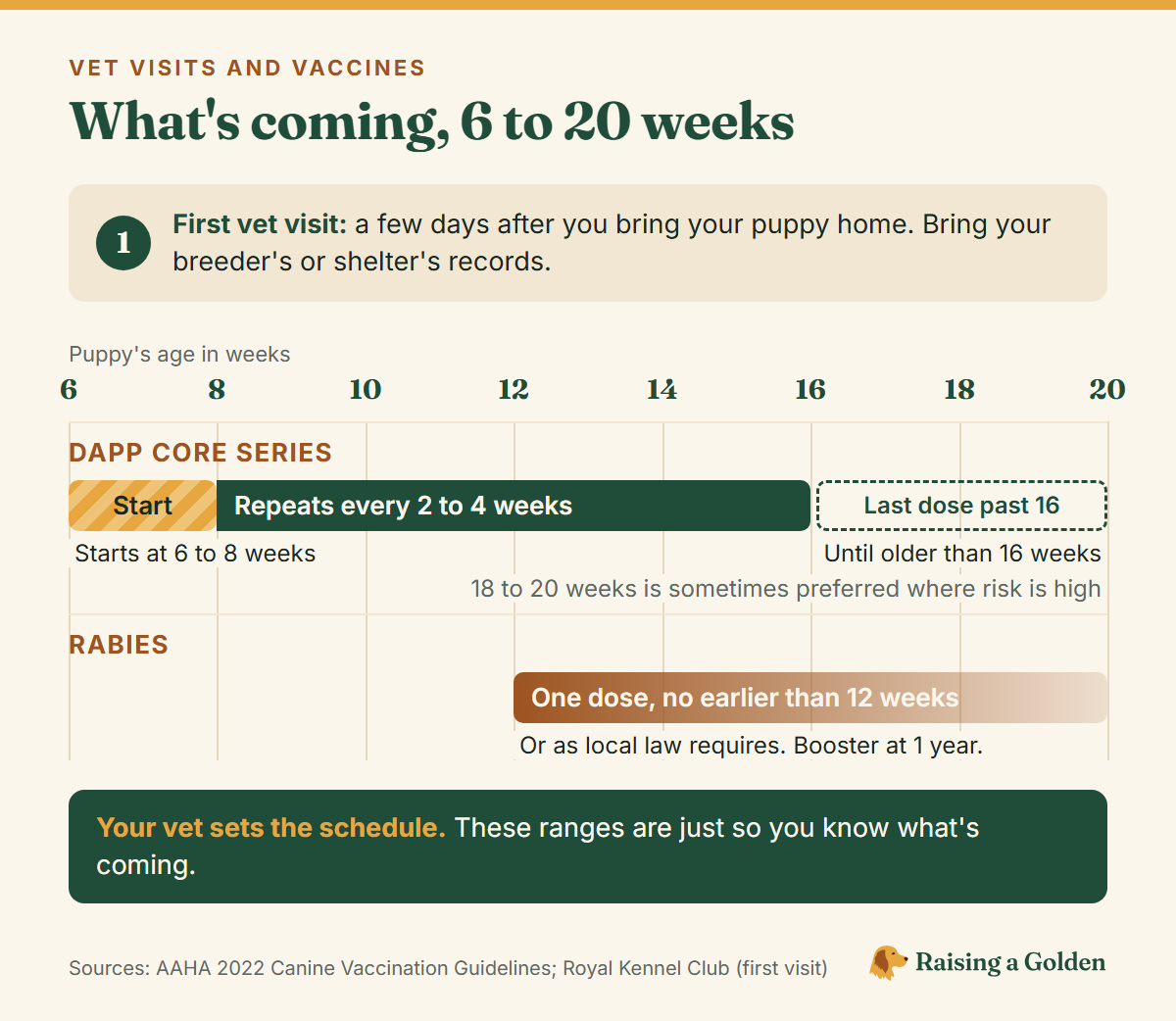
Expect several vet visits in these weeks. Your vet sets the vaccine schedule. These ranges are just so you know what’s coming:
-
First visit. The UK’s Royal Kennel Club suggests a few days after you bring your puppy home. We didn’t find a US group that gives a number.
-
Core series. DAPP starts at 6 to 8 weeks and repeats every 2 to 4 weeks until your puppy is older than 16 weeks, with 18 to 20 weeks sometimes preferred where risk is high.
-
Rabies. One dose at 3 months or older, or as local law requires, with a booster 1 year later.
Don’t put socialization on hold until the last shot. Behavior problems, not infectious disease, are the number one cause of death for dogs under 3. Ask your vet which places are safe for now.
How we built these schedules
These sample days aren’t one dog’s routine. We built them from the AKC’s meal counts, potty triggers and sleep hours, the AKC and Ohio State bladder rules, and vet behavior experts’ advice on socialization. Where sources disagree, we show both. Where we couldn’t find one, we send you to your vet.
The few products linked here (a crate, an enzymatic cleaner and a chew toy) are picks that fit a golden, based on the advice next to each one and a golden’s adult size of 55 to 75 pounds. We haven’t tested them ourselves, and nobody sent them to us.
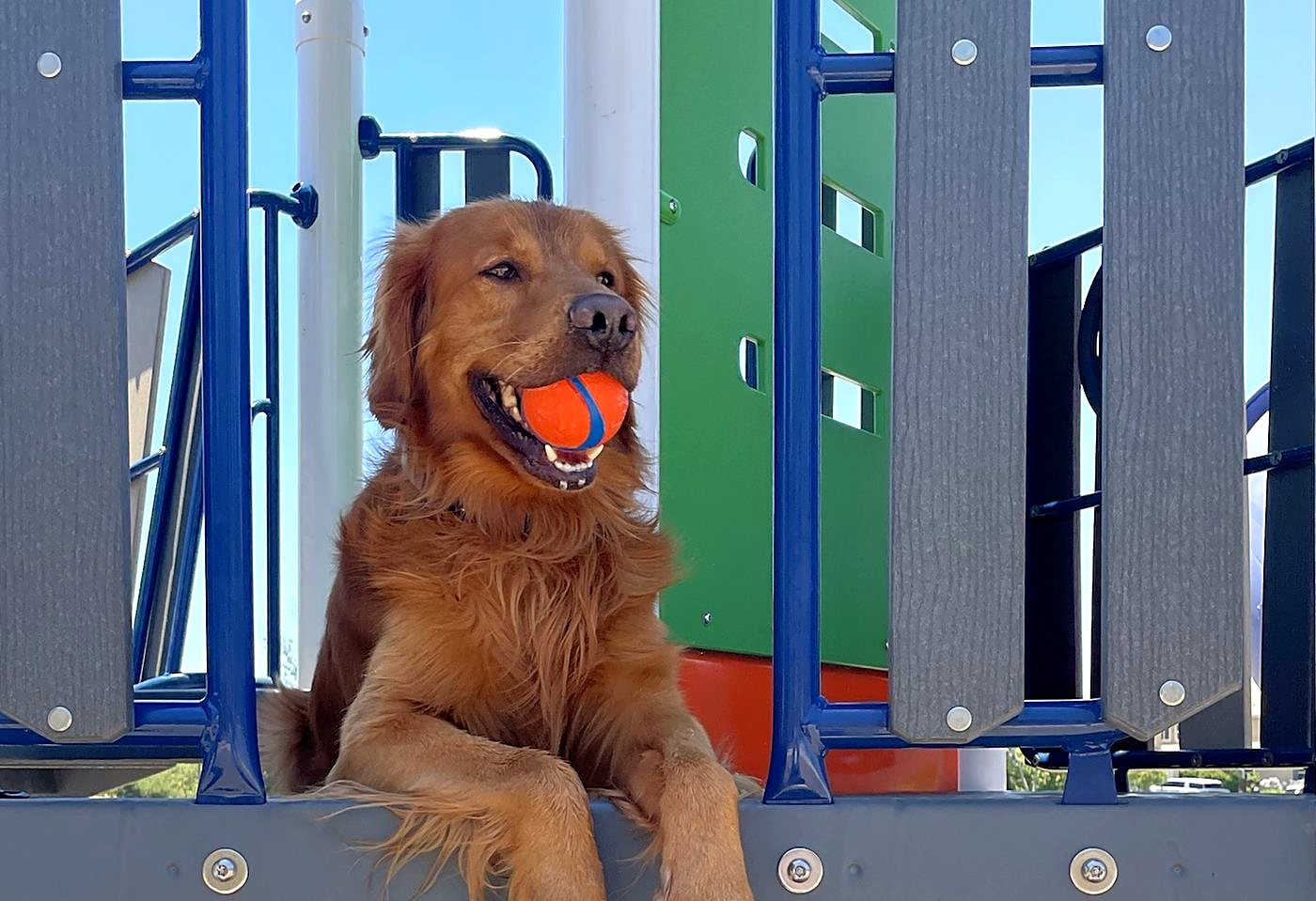
What we do have is one adult red golden.
FAQs
My 8-week-old cried in the crate all night. Is that normal?
It’s common. Whining after your puppy has settled usually means boredom, hunger or a potty need. Take them out if it’s been a while, and don’t leave them to cry it out.
Should I wake my puppy at night to pee?
The AKC’s approach is to keep the crate close so you hear the whimper, then carry a small puppy outside. If your puppy can’t make it through the night yet, the AKC also suggests setting an alarm so you’re up a little before they’d wake and cry. If you’re unsure, ask your vet.
When will my golden puppy sleep through the night?
We didn’t find a source that gives a set age. At 3 months the bladder rules give about 3 to 4 hours, so don’t expect a full night right away. With early training, most 6-month-olds can be counted on to go outside most of the time.
When should I cut off water before bed?
Ask your vet. We didn’t find a reputable source for a cutoff time, so we won’t guess. Do skip food in the 2 hours before bed and go out right before you turn in.
Bottom line
Four meals, a potty trip at every change of activity, 18 to 20 hours of sleep, short training and a little safe socialization every day. Plan a midday break if you work, let your vet set the vaccines and exercise limits, and fit the times to the puppy in front of you.
Get the free Golden Puppy 90-Day Plan: a printable schedule for 8, 10 and 12 weeks, the before-day-one shopping list, and a week-by-week checklist for your first three months.
Keep reading: golden retriever puppy checklist: what to buy before day one · how to crate train a golden retriever puppy (including the first nights) · golden retriever puppy biting: what’s normal and how to stop it
Sources
-
American Kennel Club, “Puppy Feeding Fundamentals”: https://www.akc.org/expert-advice/nutrition/puppy-feeding-fundamentals/
-
American Kennel Club, “Puppy Potty Training Timeline”: https://www.akc.org/expert-advice/training/puppy-potty-training-timeline/
-
Ohio State University Indoor Pet Initiative, “Housetraining Dogs”: https://indoorpet.osu.edu/dogs/puppy/housetraining-dogs
-
American Kennel Club, “How Much Do Puppies Sleep?”: https://www.akc.org/expert-advice/health/how-much-do-puppies-sleep/
-
AVSAB, “Position Statement on Puppy Socialization”: https://avsab.org/wp-content/uploads/2019/01/Puppy-Socialization-Position-Statement-FINAL.pdf
-
AVMA, literature review on socialization of puppies and kittens: https://www.avma.org/sites/default/files/2024-09/avma-lit-review-socialization-puppies-kittens-0924.pdf
-
American Kennel Club, “Puppies: Mental and Physical Exercise”: https://www.akc.org/expert-advice/health/puppies-mental-physical-exercise/
-
American Kennel Club, “How to Crate Train a Puppy”: https://www.akc.org/expert-advice/training/how-to-crate-train-a-puppy/
-
American Kennel Club, “How to Potty Train a Puppy”: https://www.akc.org/expert-advice/training/how-to-potty-train-a-puppy/
-
American Kennel Club, “How to Stop Puppy Biting and Train Bite Inhibition”: https://www.akc.org/expert-advice/training/stop-puppy-biting/
-
ASPCA, “Mouthing, Nipping and Biting in Puppies”: https://www.aspca.org/pet-care/dog-care/common-dog-behavior-issues/mouthing-nipping-and-biting-puppies
-
VCA Animal Hospitals, “Retained Deciduous Teeth (Baby Teeth) in Dogs”: https://vcahospitals.com/know-your-pet/retained-deciduous-teeth-baby-teeth-in-dogs
-
Golden Retriever Club of America, “Grooming Your Golden” by Joanne Lastoka: https://grca.org/about-the-breed/articles/grooming-your-golden-joanne-lastoka/
-
PDSA, “Exercising your puppy”: https://www.pdsa.org.uk/pet-help-and-advice/looking-after-your-pet/puppies-dogs/exercising-your-puppy
-
Krontveit RI et al., “Housing- and exercise-related risk factors associated with the development of hip dysplasia as determined by radiographic evaluation in a prospective cohort of Newfoundlands, Labrador Retrievers, Leonbergers, and Irish Wolfhounds in Norway,” American Journal of Veterinary Research, 2012: https://doi.org/10.2460/ajvr.73.6.838
-
Royal Kennel Club, “Your puppy’s first visit to the vet”: https://www.royalkennelclub.com/health-and-dog-care/health-dog-care/health/health-and-care/a-z-of-health-and-care-issues/your-puppys-first-visit-to-the-vet/
-
AAHA, 2022 Canine Vaccination Guidelines, core and noncore vaccines: https://www.aaha.org/resources/2022-aaha-canine-vaccination-guidelines/recommendations-for-core-and-noncore-canine-vaccines/
-
AAHA, 2022 Canine Vaccination Guidelines, rabies: https://www.aaha.org/resources/2022-aaha-canine-vaccination-guidelines/rabies/
-
Golden Retriever Club of America, AKC breed standard: https://grca.org/about-the-breed/akc-breed-standard/
-
American Kennel Club, “Setting Schedules and Developing a Routine for Your New Puppy”: https://www.akc.org/expert-advice/training/setting-schedules-and-developing-a-routine-for-your-new-puppy/
-
AAHA, 2022 Canine Vaccination Guidelines, canine parvovirus: https://www.aaha.org/resources/2022-aaha-canine-vaccination-guidelines/canine-parvovirus-cpv/