Golden Retriever Eye Problems: PRA, Cataracts and Pigmentary Uveitis
About the health information here: it comes from vet groups and vet schools, but we’re dog owners, not vets, so for anything about your own dog’s health, check with your vet.
The short answer: In goldens, the breed club singles out pigmentary uveitis, cataracts, progressive retinal atrophy (PRA) and eyelid and eyelash problems. Uveitis usually has no early signs, so the club recommends a yearly exam by a veterinary ophthalmologist from about age 2 or 3. An eye injury, a bulging eye, a painful eye held shut or sudden blindness is an emergency.
In this guide
- What eye problems do golden retrievers get?
- What is pigmentary uveitis in golden retrievers?
- Are eye cysts in golden retrievers a problem?
- What do cataracts look like in a golden retriever?
- What is progressive retinal atrophy (PRA) in golden retrievers?
- What are the first signs of PRA in a dog?
- How do you help a golden with PRA or vision loss?
- Which DNA tests should a golden retriever have for PRA?
- What happens at a golden retriever eye exam?
- How often should golden retrievers get eye exams?
- Which golden retriever eye problems are an emergency?
- What should you ask a breeder about eyes?
- FAQs
- Bottom line
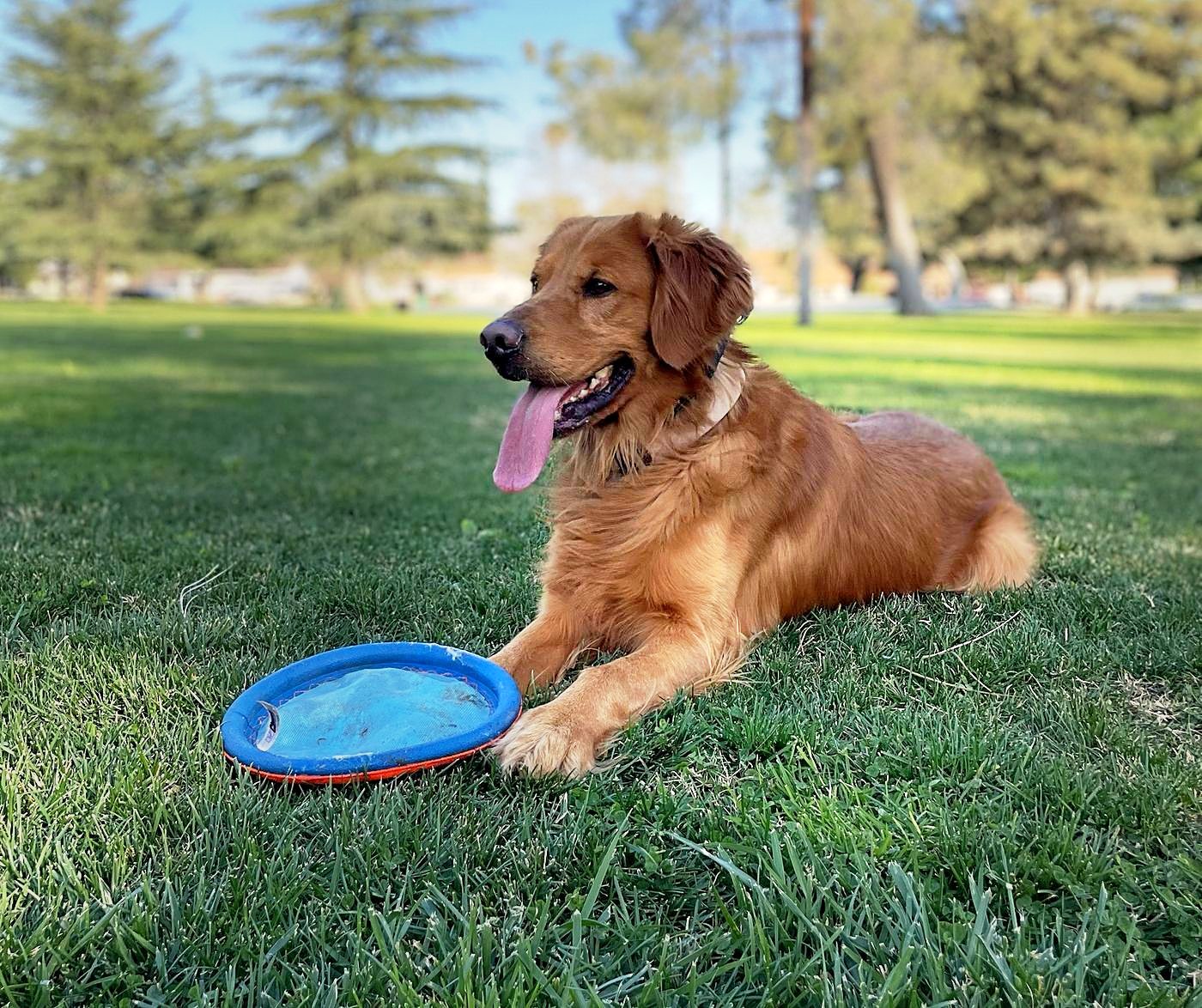
Most goldens never get pigmentary uveitis, and PRA is rare. But pigmentary uveitis stays quiet until it’s well along, so it pays to know what each one looks like and what the eye exam and DNA tests check.
What eye problems do golden retrievers get?
The Golden Retriever Club of America (GRCA) points to four: pigmentary uveitis, inherited cataracts, eyelid and eyelash problems, and a rarer one, PRA.
Here’s how often board-certified eye vets found them in 51,828 goldens screened through the OFA eye registry from 2021 to 2025:
| Problem | Found in | Usual age it shows up | What you might notice |
|---|---|---|---|
| Cataracts | 14.6% | About 6 months to 3 years (the inherited kind; sources vary) | Often nothing; sometimes a cloudy or white spot in the pupil |
| Extra eyelashes (distichiasis) | 8.4% | Any age | Often nothing; sometimes redness, squinting, discharge or rubbing |
| Uveal cysts | 4.2% one cyst, 2.8% several | Usually adults | Sometimes a small dark ball floating in the eye |
| Pigmentary uveitis | 1.0% | Usually 5 to 10 years | Nothing early; later red, teary eyes and rubbing or pawing |
| PRA | 6 dogs | Usually 3 to 6 years or older | Trouble seeing at night, wide pupils, extra eye shine |
Dogs brought in for these registry exams tend to be younger, and uveitis usually starts later in life, so studies of older goldens find a lot more of it (more below).
What is pigmentary uveitis in golden retrievers?
It’s a slow, low-grade inflammation inside the eye that’s unique to goldens and is believed to be inherited. Pigment from the back of the iris spreads onto the lens, the iris can stick to the lens, and over time it can lead to cataracts and glaucoma, a pressure buildup inside the eye that can be painful and can blind it.
It usually starts between ages 5 and 10. Dogs are diagnosed at about 8 on average, but ophthalmologists have found it as young as 2.5 (very rarely) and as old as 14.5.
Early on there are no outward signs. Later you may see redness, tearing, and rubbing or pawing at the eye. When it’s only caught after those signs show, the GRCA says about half of those eyes lose vision within months. In one report on dogs found earlier, on screening exams, 21% lost vision to glaucoma.
Ophthalmologists treat it with anti-inflammatory medicine and add glaucoma medicine as needed.
How common is it? The answer depends on who gets examined:
-
1% of goldens screened through the OFA registry (2021 to 2025)
-
5.5% of 164 goldens examined in a Purdue study in three Midwest states
-
9.9% of Midwest goldens over 8, in published research
-
23.9% of goldens over 8 in the lead researcher’s newer exam data, which hadn’t been published when she reported it in 2020
The GRCA’s view: most goldens never get it, but there’s no way yet to know which ones will. For the breed’s other health risks, see golden retriever health issues: what to watch for (and when to call the vet).
Are eye cysts in golden retrievers a problem?
Sometimes. Uveal cysts are small fluid-filled sacs from the back of the iris, and you may see one as a dark ball floating in the front of the eye. They’re harmless in most breeds, but in goldens they’re linked to uveitis, glaucoma and cataracts.
In one study of goldens examined twice, 58% of eyes with several cysts at the first exam had pigmentary uveitis at the next one. That compared with 10% of eyes with one cyst and 1% with none.
Multiple cysts don’t stop a dog from passing its OFA eye exam, but the GRCA calls them an early warning sign. It suggests eye exams every 6 months, instead of yearly, for a golden with multiple cysts.
What do cataracts look like in a golden retriever?
A cataract is any cloudy spot in the lens. It can look like small dots, cracked ice, a milky haze or white streaks in the pupil.
Inherited cataracts are fairly common in goldens. The typical one is a small spot at the back of the lens, generally in both eyes, that usually shows up between about 9 months and 3 years old (the GRCA says 1 to 3, and Merck’s vet manual says from 6 months). Some stay the same size, and most dogs with them don’t lose vision.
Cataracts can also come from diabetes, the most common disease behind them in dogs, and from inflammation such as pigmentary uveitis.
Not every cloudy-looking lens in an older golden is a cataract. Merck’s vet manual says not to confuse cataracts with the normal hardening of the lens that comes with age. The American College of Veterinary Ophthalmologists (ACVO) says that hardening can blur close-up vision, while a true cataract blocks vision. More on aging changes in senior golden retrievers: when it starts and how to care for them.
The ACVO says surgery, done by a veterinary ophthalmologist, is the only known treatment. No medical treatment has been proven to reverse, slow or prevent a cataract, and some products promoted for it make cataracts worse. If you suspect a cataract, the ACVO recommends an exam by a board-certified veterinary ophthalmologist early, before the cataract is fully formed. Merck’s manual adds that cataracts that aren’t removed still need monitoring, since glaucoma can follow.
What is progressive retinal atrophy (PRA) in golden retrievers?
PRA is an inherited disease in which the light-sensing cells of the retina slowly die, in both eyes, until the dog is blind. It isn’t painful, and there’s no approved treatment.
The night-vision cells go first, so night blindness comes before day blindness. Full blindness can take months to years.
Goldens have three known forms, and each has a DNA test:
-
prcd-PRA: found in 30+ breeds. In goldens it’s usually spotted at 3 to 6 years or older.
-
GR_PRA1: the main form in European lines, with signs around age 6. The 2011 study that found it didn’t find it in the US goldens tested.
-
GR_PRA2: about 30% of golden PRA cases in the research, with signs around age 4.
About 9% of PRA cases in goldens still have no known gene, so no DNA test covers them. All three known forms are recessive: a dog needs two copies, one from each parent, to get the disease.
What are the first signs of PRA in a dog?
Trouble seeing in dim light usually comes first. Dogs adapt so well that signs may not show until the disease is advanced, and they’re easier to spot at night or somewhere new. Cornell’s vet school lists:
-
Wide (dilated) pupils
-
Eyes that reflect more light than usual when a light shines on them
-
Not wanting to go into a dark room or outside at night
-
Hesitating on stairs
-
Bumping into door frames, or clumsiness in new places
-
Cloudy lenses (cataracts) in both eyes later on
The ACVO notes that some dogs aren’t diagnosed until the furniture gets rearranged.
These changes build slowly. Book a vet visit and ask about seeing a veterinary ophthalmologist, who confirms PRA with an eye exam and sometimes an electroretinogram (ERG), a test of how the retina responds to light. Sudden vision loss is different (see the emergency section below).
Cataracts are common late in PRA. Removing them usually isn’t recommended, because it may not improve vision, but they still need checkups since they can lead to glaucoma.
How do you help a golden with PRA or vision loss?
Most dogs adapt well, and the ACVO says blindness is usually much harder on the owner than on the dog. Tips from the ACVO and Cornell:
-
Keep furniture where it is, since your dog builds a mental map
-
Add lighting inside and out while only night vision is affected
-
Put gates at stairs and pools
-
Keep a home base: crate, bed, food and water in one spot
-
Talk in a normal voice and let your dog know when you’re coming
-
Teach cues like “stop” and “step up,” ideally before vision fades
-
Use a leash in unfamiliar places, and no unsupervised time outside unless it’s fenced
-
Try toys that squeak or jingle
-
Consider a harness that tells people your dog is blind
Tell your breeder, too. Both parents of an affected dog carry the gene, and the GRCA recommends DNA testing close relatives of affected dogs.
Which DNA tests should a golden retriever have for PRA?
Three: prcd-PRA, GR_PRA1 and GR_PRA2. They’re cheek-swab tests from several labs, including UC Davis’s Veterinary Genetics Laboratory, and results can be recorded with the OFA.
Each result comes back one of three ways:
-
Clear: won’t get that form and can’t pass it on
-
Carrier: won’t get it, but can pass it to about half of their puppies
-
At risk (two copies): expected to develop that form
For a pet golden, start by asking the breeder for both parents’ results. If both tested clear for a form, your puppy can’t inherit that form. The GRCA says breeding a carrier is fine when the mate tested clear, since those puppies aren’t at higher risk.
Two limits: a clear result doesn’t rule out the unknown forms, and there’s no DNA test for pigmentary uveitis or cataracts. That’s why the GRCA still recommends yearly eye exams.
What happens at a golden retriever eye exam?
An OFA eye exam is a painless screening exam done only by a board-certified veterinary ophthalmologist (an ACVO Diplomate). Here’s how it goes:
-
Drops dilate your dog’s pupils, and you wait 30 to 40 minutes.
-
The ophthalmologist looks inside each eye with an indirect ophthalmoscope and a slit lamp.
-
Results go on an OFA eye registry form. You can register the result with the OFA, and a passing exam is good for 12 months.
It’s a screening exam, not a full workup. It doesn’t measure eye pressure or check for ulcers, and some early PRA can be missed. If the ophthalmologist suspects a serious problem, such as glaucoma, they’ll recommend a fuller exam.
Your regular vet is still your first call for a red or sore eye. But in a GRCA Q&A, all three ophthalmologists said catching early pigmentary uveitis is a job for an ophthalmologist, not a regular vet exam. One said it takes a slit lamp exam after the pupils are dilated.
Group “eye clinics,” often held at dog shows, offer these exams at a discounted rate, and the OFA lists many on its site. You can also find an ophthalmologist on the ACVO’s website, and you don’t need a referral.
How often should golden retrievers get eye exams?
Once a year, starting at about 2 to 3 years old, for every golden, bred or not. That’s the GRCA’s recommendation, and it adds:
-
Every 6 months if your golden has multiple uveal cysts
-
For life for any golden that’s been bred
-
Within the past 12 months for a litter’s parents, since results expire after a year
The experts don’t fully agree on start and stop ages. In the GRCA’s Q&A, one ophthalmologist starts screening at 2, one at 3 and one at 4. One said it’s usually fine to stop around 11, while another had diagnosed a dog at 13.5 and said there’s “no safety zone.”
Which golden retriever eye problems are an emergency?
Go to an emergency vet now for an eye injury or something stuck in the eye, a bulging eye, a painful eye held shut, or sudden blindness, like suddenly bumping into things or very wide pupils out of nowhere.
Pigmentary uveitis often leads to glaucoma. Sudden glaucoma brings severe pain, a red, cloudy eye and loss of vision, and Merck’s vet manual says a dog with signs of glaucoma should see a vet immediately. Glaucoma pain may show up as low energy, not eating or other changes in behavior instead of obvious squinting.
Call your vet today for redness, swelling, discharge, cloudiness, extra blinking or the third eyelid showing. Ask for an urgent appointment if the eye seems painful.
When one owner on r/goldenretrievers found a cloudy, red eye on their 2-year-old golden, they asked, “Is he going blind?” Only an exam can say, which is why cloudiness gets a same-day call.
Slow changes, like night blindness that builds over weeks or months, aren’t an emergency, but they’re not wait-and-see either. Book a vet visit. For other symptoms sorted by urgency, with a chart to print, see our dog symptom guide.
What should you ask a breeder about eyes?
Ask for these on the parents, and check them yourself:
-
A current OFA eye exam on both parents, done in the last 12 months
-
Current eye exams on the grandparents, since uveitis often shows up late
-
Any “multiple uveal cysts” in parents or grandparents, which the GRCA says to weigh heavily
-
PRA DNA results for prcd, GR_PRA1 and GR_PRA2
You can look up eye results at ofa.org with each parent’s registration number.
Get the free Golden Puppy 90-Day Plan: a shopping list, a daily schedule at 8, 10 and 12 weeks, and a week-by-week checklist to start your golden off right.
FAQs
Can golden retrievers go blind?
Yes. PRA leads to blindness, and pigmentary uveitis can blind an eye through glaucoma. Most goldens never get either, and blind dogs usually adapt well.
Do golden retriever puppies have eye problems?
The main ones usually start later: inherited cataracts from about 6 months to 3 years (sources vary), PRA and uveitis years after that. A few problems, like retinal folds or unusually small eyes, are there from birth, and the OFA sets no minimum age for an eye exam once a puppy’s eyes are open.
Bottom line
Most goldens never get pigmentary uveitis or PRA, but uveitis is common enough and quiet enough that the GRCA recommends a yearly ophthalmologist exam from about age 2 or 3. Ask any breeder for the parents’ current eye exams and PRA DNA results, and treat an eye injury, a bulging eye, a painful eye held shut or sudden blindness as an emergency. For anything about your own dog’s eyes, check with your vet.
Sources
-
Golden Retriever Club of America, Pigmentary Uveitis Alert for Breeders, Potential Buyers, and Owners (2024): https://grca.org/wp-content/uploads/2024/02/GRPU-Alert-for-Breeders-Buyers-Owners-2024.pdf
-
Golden Retriever Club of America, Pigmentary Uveitis Letter to Owners: https://grca.org/about-the-breed/health-research/pigmentary-uveitis-letter-to-owners/
-
Golden Retriever Club of America Health & Genetics Committee, “Expert Ophthalmologists Answer GRCA Member Questions about Pigmentary Uveitis”: https://grca.org/wp-content/uploads/2015/08/eyes-health.pdf
-
Golden Retriever Club of America Health & Genetics Committee, “Progressive Retinal Atrophy in Golden Retrievers” (2022): https://grca.org/wp-content/uploads/2022/08/PRA-update-30-July-2022-final.pdf
-
Golden Retriever Club of America, Health Screenings for the Parents of a Litter: https://grca.org/about-the-breed/health-research/health-screenings-for-the-parents-of-a-litter/
-
ACVO Genetics Committee and OFA, The Blue Book: Ocular Disorders Presumed to be Inherited in Purebred Dogs, 17th edition (2025): https://ofa.org/wp-content/uploads/2026/06/Blue-Book-2025-17th-Edition.pdf
-
ACVO Genetics Committee, The Blue Book, 12th edition (2019 to 2020): https://ofa.org/bluebook-v12
-
Orthopedic Foundation for Animals, Eye Certification (Companion Animal Eye Registry): https://ofa.org/diseases/eye-certification/
-
Orthopedic Foundation for Animals, Eye FAQs: https://ofa.org/diseases/eye-disease/eye-faqs/
-
American College of Veterinary Ophthalmologists, Cataracts: https://www.acvo.org/common-conditions-1/2018/3/1/cataracts
-
American College of Veterinary Ophthalmologists, PRA (Progressive Retinal Atrophy): https://www.acvo.org/common-conditions-1/2018/2/2/pra
-
American College of Veterinary Ophthalmologists, Glaucoma: https://www.acvo.org/common-conditions-1/2018/2/2/glaucoma
-
American College of Veterinary Ophthalmologists, Geriatrics: https://www.acvo.org/common-conditions-1/2018/2/2/geriatrics
-
American College of Veterinary Ophthalmologists, Distichiasis: https://www.acvo.org/common-conditions-1/2018/2/2/distichiasis
-
American College of Veterinary Ophthalmologists, Living with a Blind Pet: https://www.acvo.org/tips-treatments-tricks/k3j54gbjrz2jtbltleld8festlsj8j
-
American College of Veterinary Ophthalmologists, Veterinary Ophthalmology FAQs: https://www.acvo.org/s/Veterinary-Ophthalmology-FAQs-UTD-101424.pdf
-
Merck Veterinary Manual, Dog Owners, Disorders of the Lens in Dogs: https://www.merckvetmanual.com/dog-owners/eye-disorders-of-dogs/disorders-of-the-lens-in-dogs
-
Merck Veterinary Manual, Dog Owners, Disorders of the Anterior Uvea in Dogs: https://www.merckvetmanual.com/dog-owners/eye-disorders-of-dogs/disorders-of-the-anterior-uvea-in-dogs
-
Merck Veterinary Manual, Dog Owners, Disorders of the Retina, Choroid, and Optic Disk in Dogs: https://www.merckvetmanual.com/dog-owners/eye-disorders-of-dogs/disorders-of-the-retina-choroid-and-optic-disk-ocular-fundus-in-dogs
-
Merck Veterinary Manual, Dog Owners, Glaucoma in Dogs: https://www.merckvetmanual.com/dog-owners/eye-disorders-of-dogs/glaucoma-in-dogs
-
Cornell University College of Veterinary Medicine, Riney Canine Health Center, Progressive retinal atrophy: https://www.vet.cornell.edu/departments-centers-and-institutes/riney-canine-health-center/canine-health-topics/progressive-retinal-atrophy
-
Cornell Richard P. Riney Canine Health Center, “When to go to the ER” (June 2025): https://riney.vet.cornell.edu/member-benefits-health-tips/when-to-go-to-the-er-june-2025
-
VCA Animal Hospitals, Emergencies in Dogs: https://vcahospitals.com/know-your-pet/emergencies-in-dogs
-
PDSA, Eye problems in dogs: https://www.pdsa.org.uk/pet-help-and-advice/pet-health-hub/symptoms/eye-problems-in-dogs
-
PDSA, Painful eye (eye held closed) in dogs: https://www.pdsa.org.uk/pet-help-and-advice/pet-health-hub/symptoms/painful-eyeeye-held-closed-in-dogs
-
UC Davis Veterinary Genetics Laboratory, Progressive Retinal Atrophy (PRA1 and PRA2) in Golden Retrievers: https://vgl.ucdavis.edu/test/golden-retriever-pra
-
UC Davis Veterinary Genetics Laboratory, Progressive Rod-Cone Degeneration (PRA-prcd): https://vgl.ucdavis.edu/test/pra-prcd
-
Townsend WM et al., “Golden retriever pigmentary uveitis: Challenges of diagnosis and treatment,” Veterinary Ophthalmology (2020): https://pmc.ncbi.nlm.nih.gov/articles/PMC7540390/
-
Townsend WM, Gornik KR, “Prevalence of uveal cysts and pigmentary uveitis in Golden Retrievers in three Midwestern states,” JAVMA (2013): https://pubmed.ncbi.nlm.nih.gov/24134580/
-
Downs LM et al., “A frameshift mutation in golden retriever dogs with progressive retinal atrophy endorses SLC4A3 as a candidate gene for human retinal degenerations,” PLoS ONE (2011): https://pubmed.ncbi.nlm.nih.gov/21738669/
-
Downs LM et al., “A novel mutation in TTC8 is associated with progressive retinal atrophy in the golden retriever,” Canine Genetics and Epidemiology (2014): https://pubmed.ncbi.nlm.nih.gov/26401321/
-
Owner quote, r/goldenretrievers (“Is he going blind?”): https://redd.it/1sbwbgq