
Should I Call the Vet? A Dog Symptom Guide for Owners (Printable)
About the health information here: it comes from vet groups and vet schools, but we’re dog owners, not vets, so for anything about your own dog’s health, check with your vet.
The short answer: Go to an emergency vet now for trouble breathing, collapse, pale or blue gums, a swollen belly with retching, a seizure over five minutes, poisoning, heatstroke or straining without peeing. Call your vet the same day for most other new signs. Only watch at home when one mild sign shows up in a dog who’s otherwise bright and normal.
In this guide
- How do you use this guide?
- Which signs mean go to an emergency vet right now?
- Is it an emergency when your dog is vomiting, has diarrhea or won’t eat?
- What should you do if your dog is having trouble breathing or coughing?
- What should you do if your dog has a seizure or collapses?
- When do eye, ear and skin problems need a vet?
- What about limping, wounds, poisons and heat?
- When is a peeing problem urgent?
- How do you check your dog’s gums and capillary refill time?
- What’s a normal breathing rate for a resting dog?
- What’s a normal temperature for a dog?
- What should you tell the vet when you call?
- Who do you call about a possible poisoning?
- What do the words you hear at the vet mean?
- FAQs
- Bottom line
Print the one-page chart (PDF, free, no signup)
It’s late, your dog just threw up twice, and your vet’s office is closed. Do you drive to the emergency clinic or wait for morning?
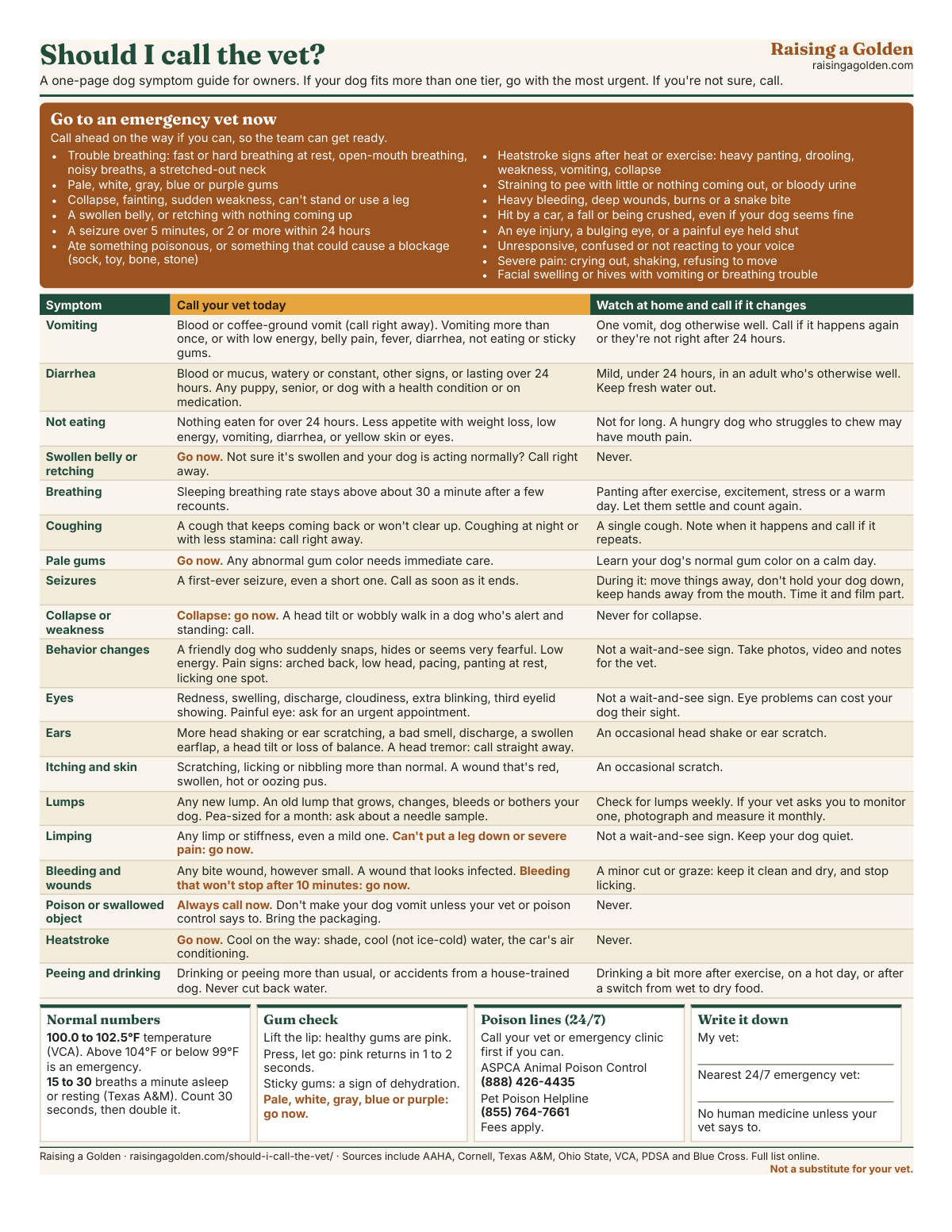
This guide sorts common dog symptoms by urgency, using owner advice from vet schools, the American Animal Hospital Association (AAHA), VCA Animal Hospitals and the UK vet charities PDSA and Blue Cross. It works for any dog, and there’s a one-page chart to print.
How do you use this guide?
Each symptom has three tiers:
-
Go now means go to an emergency vet now. Call ahead on the way if you can, so the team can get ready.
-
Call today means call your vet today. Your vet will tell you how soon your dog needs to be seen. If they’re closed, call your nearest emergency clinic.
-
Watch at home means watch at home and call if it changes. It’s only for one mild sign in a dog who’s otherwise bright and normal.
Three ground rules:
-
If your dog fits more than one tier, go with the most urgent.
-
Puppies, seniors, and dogs with health problems or on medication need help sooner. Dehydration hits the very young and very old hardest.
-
If you’re not sure, call. As Cornell’s canine health center puts it, you know your dog better than anyone.
Download the one-page chart (PDF, free, no signup)
Which signs mean go to an emergency vet right now?
-
Trouble breathing: fast or hard breathing at rest, breathing with an open mouth, noisy breaths, or a stretched-out neck
-
Pale, white, gray, blue or purple gums
-
Collapse, fainting, sudden weakness, or not being able to stand or use a leg
-
A swollen belly, or retching with nothing coming up
-
A seizure lasting more than five minutes, or two or more within 24 hours
-
Eating something poisonous, or something that could cause a blockage (a sock, toy, bone or stone)
-
Heatstroke signs after heat or exercise: heavy panting, drooling, weakness, vomiting or collapse
-
Straining to pee with little or nothing coming out
-
Heavy bleeding, deep wounds, burns or a snake bite
-
Being hit by a car, falling or being crushed, even if your dog seems fine
-
An eye injury, a bulging eye, or a painful eye held shut
-
Being unresponsive, confused or not reacting to your voice
-
Severe pain: crying out, shaking or refusing to move
-
Facial swelling or hives with vomiting or breathing trouble after a sting, bite or unknown exposure
Internal injuries don’t always show right away, so get checked after any accident.
Is it an emergency when your dog is vomiting, has diarrhea or won’t eat?
Vomiting
-
Go now: retching with nothing coming up, especially with a bloated belly. Vomiting with collapse or confusion. You think your dog ate something toxic or something that could get stuck.
-
Call today: blood in the vomit, or vomit like coffee grounds (call right away). Vomiting more than once, or with low energy, belly pain, fever, diarrhea, not eating, or sticky gums and sunken eyes (signs of dehydration).
-
Watch at home: one vomit in a dog who’s otherwise well. Many sudden cases settle within 24 hours. Call if it happens again, your dog isn’t right after 24 hours, or things get worse.
Diarrhea
-
Go now: severe bloody diarrhea with vomiting and weakness or collapse.
-
Call today: blood or mucus, severe or constant watery diarrhea, or diarrhea with vomiting, low energy, belly pain or not eating. Diarrhea lasting more than 24 hours. Any puppy, senior, or dog with a health condition or on medication (especially anti-inflammatory painkillers).
-
Watch at home: mild diarrhea for less than 24 hours in an adult who’s otherwise well. Keep fresh water out.
Not eating
-
Go now: not eating along with any go-now sign.
-
Call today: nothing eaten for more than 24 hours. A smaller appetite with weight loss, low energy, drooling, vomiting, diarrhea, or yellow skin or eyes.
-
Watch at home: not for long. Get your vet involved early in any change in eating. A dog who seems hungry but struggles to chew may have mouth pain.
Swollen belly or retching
-
Go now: a swollen belly, especially with retching that brings nothing up, drooling, pacing, pale gums or weakness. This can be bloat (GDV), where the stomach fills with gas and twists. Cornell says it’s fatal without treatment, and more than 80% of dogs survive with it. Large, deep-chested dogs are most at risk, but any dog can get it.
-
Call today: your dog is acting normally and you’re not sure the belly is swollen. Call right away.
-
Watch at home: never.
What should you do if your dog is having trouble breathing or coughing?
Breathing trouble
-
Go now: any trouble breathing: fast or open-mouthed breathing, bluish gums, the belly working hard, a stretched-out neck, or wheezing. Keep the car cool on the way.
-
Call today: a sleeping breathing rate that stays above about 30 breaths a minute after a few recounts.
-
Watch at home: panting after exercise, excitement, stress or on a warm day is normal. Let your dog settle somewhere cool and count again.
Coughing
-
Go now: coughing with trouble breathing or a bluish tongue or gums.
-
Call today: a cough that keeps coming back or doesn’t clear up quickly. Coughing at night, or with less stamina than usual, can be a sign of heart trouble, so call right away.
-
Watch at home: a single cough. Note when it happens and call if it repeats.
Pale or discolored gums
-
Go now: pale, white, gray, blue or purple gums, which AAHA says can mean internal bleeding, heart disease or breathing problems. Pale gums with fast breathing, a weak pulse and cold ears or feet are signs of shock.
-
Call today: doesn’t apply. Any abnormal gum color needs immediate care.
-
Watch at home: learn your dog’s normal gum color now (see the gum check below). For golden-specific reasons, see golden retriever health issues: what to watch for (and when to call the vet).
What should you do if your dog has a seizure or collapses?
Seizures
-
Go now: a seizure lasting more than five minutes, or two or more within 24 hours. If it stops on the way and your dog stays quiet, Cornell says the most dangerous part is over, but your dog still needs to be seen.
-
Call today: a first-ever seizure, even a short one. Call as soon as it ends.
-
Watch at home: during a seizure, move things away, don’t hold your dog down, and keep your hands away from the mouth. Time it and film part of it. Many dogs are wobbly or confused for a while afterward.
Cornell lists golden retrievers among the breeds with higher rates of seizure conditions.
Collapse or sudden weakness
-
Go now: collapse, fainting, sudden weakness, trouble getting up, or not using one or more legs.
-
Call today: a head tilt or wobbly walk in a dog who’s alert and standing. If your dog falls and can’t get up, go now.
-
Watch at home: never for collapse.
Behavior changes
-
Go now: unresponsive, disoriented or not reacting to your voice. Crying out, shaking or refusing to move from pain.
-
Call today: a friendly dog who suddenly snaps, hides or seems very fearful. Low energy, or a dog who just isn’t quite right. Pain signs include an arched back, low head, pacing, panting at rest, licking one spot and eating less.
-
Watch at home: not a wait-and-see sign. Before the visit, take photos, video and notes, because some dogs hide pain at the clinic. For older dogs, see senior golden retrievers: when it starts and how to care for them.
When do eye, ear and skin problems need a vet?
Eye problems
-
Go now: an eye injury, something stuck in the eye, a bulging eye, or a painful eye held shut. Sudden blindness, bumping into things, or very wide pupils.
-
Call today: redness, swelling, discharge, cloudiness, extra blinking or the third eyelid showing. Ask for an urgent appointment if the eye seems painful.
-
Watch at home: not a wait-and-see sign. Eye problems can worsen fast and cost your dog their sight.
Ear problems
-
Go now: both ears suddenly swollen and puffy, with swelling of the face, eyes, nose or feet. That can signal a severe allergic reaction.
-
Call today: more head shaking or ear scratching than usual, a bad smell, discharge, redness or a swollen earflap. A head tilt, loss of balance or flickering eyes. A head tremor your dog can’t control needs a call straight away.
-
Watch at home: most dogs shake their head or scratch an ear now and then. Call if it becomes regular. For goldens, see golden retriever ear infections: signs, causes and prevention.
Itching and skin
-
Go now: hives or facial swelling, especially with vomiting or breathing trouble.
-
Call today: scratching, licking or nibbling more than normal. Your vet needs to find the cause before you try anything at home. A wound that’s red, swollen, hot or oozing pus.
-
Watch at home: an occasional scratch is normal. For goldens, see golden retriever itchy skin: causes, hot spots and when to see the vet.
Lumps and bumps
-
Go now: sudden swelling after an insect bite, with breathing trouble, collapse, vomiting or diarrhea.
-
Call today: any new lump, even one that looks harmless. An old lump that grows, changes, gets less movable, bleeds or bothers your dog. Veterinary oncologist Dr. Sue Ettinger’s rule: a pea-sized lump that’s been there a month should be sampled with a needle.
-
Watch at home: check for lumps at least weekly. If your vet asks you to monitor one, photograph it, measure it monthly, and note any changes.
What about limping, wounds, poisons and heat?
Limping
-
Go now: your dog can’t put a leg down, a leg might be broken, there’s severe pain or a serious wound, or the back legs suddenly won’t work.
-
Call today: any limp or stiffness, even a mild one. Some dogs are very good at hiding pain.
-
Watch at home: not a wait-and-see sign. Keep your dog quiet until they’ve been checked.
Bleeding and wounds
-
Go now: blood that spurts, pools quickly, or soaks through a bandage within minutes, or bleeding that hasn’t stopped after 10 minutes. Press a clean pad firmly on it on the way. Deep wounds, burns, wounds with something stuck in them, and wounds to the head, eyes, chest, belly or groin.
-
Call today: any bite wound, however small, since bites easily get infected. A wound that looks infected.
-
Watch at home: a minor cut or graze. Most heal in a few days if kept clean and dry and your dog can’t lick them.
Poison or a swallowed object
-
Go now: call your vet, emergency clinic or a poison line right away if your dog ate something toxic (like chocolate, grapes, onions, xylitol, medicines, cleaning products, antifreeze or rat poison) or something that could cause a blockage. Don’t wait for signs, which can take days to show.
-
Call today: this one is always “call now.”
-
Watch at home: never. Don’t make your dog vomit unless your vet or poison control tells you to. Bring the packaging.
Heatstroke
-
Go now: heavy panting, drooling, weakness, vomiting, diarrhea, confusion or collapse after heat or hard exercise. Start cooling on the way: shade, cool (not ice-cold) water on the coat, and the car’s air conditioning. Get checked even if your dog seems to recover.
-
Call today: doesn’t apply.
-
Watch at home: never. Cornell says older, overweight, flat-faced, and thick- or dark-coated dogs are at higher risk, so golden owners should take hot days seriously.
When is a peeing problem urgent?
Straining, or drinking and peeing more
-
Go now: straining to pee with little or nothing coming out, or bloody urine. A urinary blockage is more common in males and can be deadly.
-
Call today: drinking or peeing more than usual, or accidents from a house-trained dog. Know how much your dog drinks in 24 hours, and never cut back their water.
-
Watch at home: drinking a bit more after exercise, on a hot day, or after a switch from wet to dry food can be normal. Call if it doesn’t settle.
How do you check your dog’s gums and capillary refill time?
-
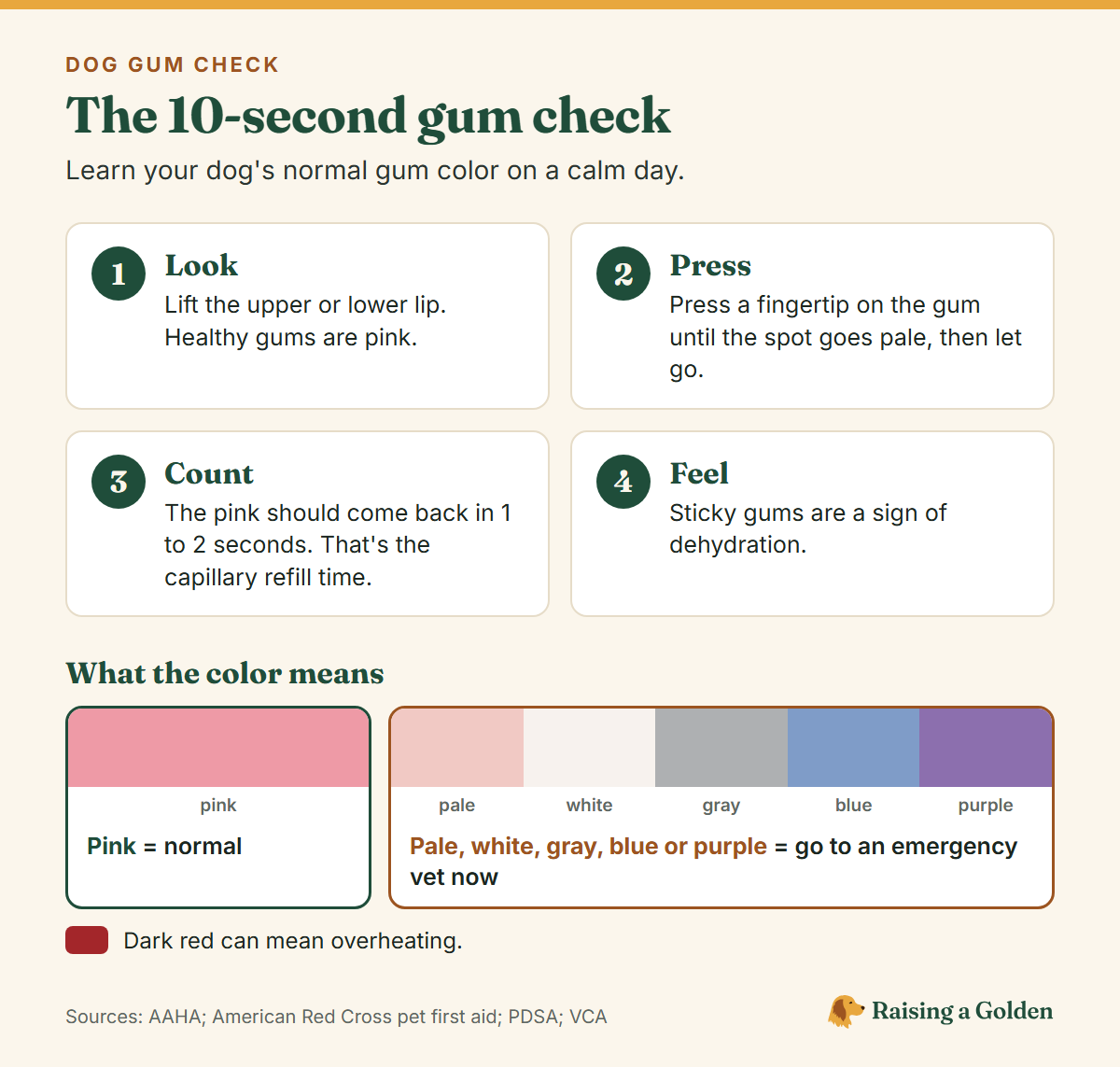
Look: lift the upper or lower lip. Healthy gums are pink.
-
Press: press a fingertip on the gum until the spot goes pale, then let go.
-
Count: the pink should come back in 1 to 2 seconds. That’s the capillary refill time.
-
Feel: sticky gums are a sign of dehydration.
Pale, white, gray, blue or purple gums mean go now. Dark red gums can show up in an overheated dog.
The American Red Cross pet first aid guide adds a dehydration check: lift the skin between the shoulder blades. It should spring right back. If it stays tented, your dog may be dehydrated.
What’s a normal breathing rate for a resting dog?
Texas A&M’s veterinary cardiology team says most dogs breathe 15 to 30 times a minute while resting or asleep, and lower rates are fine in a healthy dog. Panting from heat, stress or exercise doesn’t count.
-
Wait until your dog is sleeping quietly or resting calmly. PDSA says to skip it if they’re dreaming.
-
Watch the chest. One rise and fall is one breath.
-
Count for 30 seconds, then double it.
If it’s consistently above about 30, recount a few times over the next couple of hours, and call your vet if it stays high. Fast breathing with other signs can be an emergency. Ask your vet what’s normal for your dog.

What’s a normal temperature for a dog?
VCA puts a dog’s normal temperature at 100.0°F to 102.5°F (37.7°C to 39.2°C). Merck’s pet owner manual gives 101°F to 102.5°F. VCA says above 104°F (40°C) or below 99°F (37.2°C) is an emergency, and Cornell says heatstroke means a temperature of 105°F or higher.
To check, use a lubricated digital thermometer in the rectum, ideally with a helper. An excited dog can read high, so let them settle for 10 minutes and recheck.
What should you tell the vet when you call?
These details help your vet judge how urgent it is:
-
What you’re seeing, when it started, and how often
-
Your dog’s age, weight, health conditions and medications
-
For a possible poisoning: the brand name and ingredients, how much, and when. Bring the packaging or a photo of the plant.
-
For a seizure: how long it lasted, and a video if you have one
-
For pain, limping or odd behavior: photos, video and notes from home
Don’t give human medicine, including painkillers, unless your vet says to, since some are highly toxic to dogs. Don’t make your dog vomit without your vet’s go-ahead. Even a gentle dog may bite when hurt or scared. And save your nearest 24/7 emergency vet’s name, address and number in your phone now.
Who do you call about a possible poisoning?
Call your own vet or emergency clinic first if you can. Two animal poison lines also answer around the clock:
-
ASPCA Animal Poison Control Center: (888) 426-4435. A consultation fee may apply.
-
Pet Poison Helpline: (855) 764-7661. It charges a per-incident fee ($89 when we checked in October 2026), with follow-up calls included.
Cornell’s canine health center calls the fee well worth it.
What do the words you hear at the vet mean?
-
Anaphylaxis: a severe allergic reaction that can cause sudden collapse and breathing trouble.
-
Capillary refill time (CRT): how fast pink returns to a pressed gum. Normal is 1 to 2 seconds.
-
Cluster seizures: more than one seizure within 24 hours.
-
FNA (fine needle aspirate): cells taken from a lump with a small needle, often during a regular visit.
-
GDV or bloat: the stomach fills with gas, food or fluid and twists. It’s an emergency.
-
PU/PD: peeing more and drinking more than normal.
-
Regurgitation: food coming back up quickly with no heaving. Vomiting involves belly contractions and effort.
-
Retching: heaving with little or nothing coming up.
-
Shock: a whole-body reaction to things like blood loss or heatstroke, with fast breathing, a weak pulse and pale gums.
-
Status epilepticus: a seizure that doesn’t stop on its own, usually more than five minutes.
FAQs
Can it wait until morning?
If it’s on the go-now list, no. For anything else, call your vet’s after-hours line or an emergency clinic, and they’ll tell you how soon your dog needs to be seen. Some telehealth services also connect you to a licensed vet for a fee.
Bottom line
Learn the go-now list, check your dog’s normal gums and sleeping breathing rate on a calm day, and save your nearest 24/7 emergency vet and a poison line in your phone. For everything in between, call your vet. Print the chart, and check with your vet about anything to do with your own dog.
Sources
-
AAHA, “Help! Is This a Pet Emergency?”: https://www.aaha.org/resources/help-is-this-a-pet-emergency/
-
Cornell Richard P. Riney Canine Health Center, “When to go to the ER” (June 2025): https://riney.vet.cornell.edu/member-benefits-health-tips/when-to-go-to-the-er-june-2025
-
Cornell University College of Veterinary Medicine, Recognizing and responding to canine respiratory distress: https://www.vet.cornell.edu/departments-centers-and-institutes/riney-canine-health-center/canine-health-information/recognizing-and-responding-canine-respiratory-distress
-
Cornell University College of Veterinary Medicine, Heatstroke: A medical emergency: https://www.vet.cornell.edu/departments-centers-and-institutes/riney-canine-health-center/canine-health-information/heatstroke-medical-emergency
-
Cornell University College of Veterinary Medicine, Managing seizures: https://www.vet.cornell.edu/departments-centers-and-institutes/riney-canine-health-center/canine-health-information/managing-seizures
-
Cornell University College of Veterinary Medicine, Recognizing pain in dogs: https://www.vet.cornell.edu/departments-centers-and-institutes/riney-canine-health-center/canine-health-information/recognizing-pain-dogs
-
Cornell University College of Veterinary Medicine, First-aid for poisonous substances: https://www.vet.cornell.edu/departments-centers-and-institutes/riney-canine-health-center/canine-health-information/first-aid-poisonous-substances
-
Cornell University College of Veterinary Medicine, Gastric dilatation volvulus (GDV) or “bloat”: https://www.vet.cornell.edu/departments-centers-and-institutes/riney-canine-health-center/canine-health-topics/gastric-dilatation-volvulus-gdv-or-bloat
-
Cornell University College of Veterinary Medicine, Vomiting: https://www.vet.cornell.edu/departments-centers-and-institutes/riney-canine-health-center/canine-health-information/vomiting
-
The Ohio State University Veterinary Medical Center, What Constitutes a Pet Emergency?: https://vmc.vet.osu.edu/resources/what-constitutes-pet-emergency
-
Texas A&M College of Veterinary Medicine, Cardiology Service, “Measuring Your Pet’s Breathing Rate” (Client Information Series): https://vethospital.tamu.edu/hospital/wp-content/uploads/sites/15/2018/01/cardiology-home-breathing.pdf
-
VCA Animal Hospitals, Emergencies in Dogs: https://vcahospitals.com/know-your-pet/emergencies-in-dogs
-
VCA Animal Hospitals, First Aid for Dogs: Shock, Rescue Breathing, and CPR: https://vcahospitals.com/know-your-pet/first-aid-for-dogs
-
VCA Animal Hospitals, Vomiting in Dogs: https://vcahospitals.com/know-your-pet/vomiting-in-dogs
-
VCA Animal Hospitals, Diarrhea in Dogs: https://vcahospitals.com/know-your-pet/diarrhea-in-dogs
-
VCA Animal Hospitals, Anorexia in Dogs: https://vcahospitals.com/know-your-pet/anorexia-in-dogs
-
VCA Animal Hospitals, Heat Stroke in Dogs: https://vcahospitals.com/know-your-pet/heat-stroke-in-dogs
-
VCA Animal Hospitals, Taking Your Pet’s Temperature: https://vcahospitals.com/know-your-pet/taking-your-pets-temperature
-
VCA Animal Hospitals Urgent Care, Runny Nose, Coughing or Sneezing: https://vcahospitals.com/urgent-care/health-concerns/runny-nose-coughing-sneezing
-
Merck Veterinary Manual, Pet Owner Version, Normal Physiological Values for Dogs: https://www.merckvetmanual.com/multimedia/table/normal-physiological-values-for-dogs
-
American Red Cross, What’s a Normal Dog Temperature, Heart and Breathing Rate? (information provided by Deborah C. Mandell, VMD, Penn Vet): https://www.redcross.org/take-a-class/resources/learn-pet-first-aid/dog/normal-temperature-heart-breathing-rate
-
Blue Cross, Emergencies and first aid in dogs: https://www.bluecross.org.uk/advice/dog/basic-first-aid-for-dogs
-
PDSA, Vomiting in dogs: https://www.pdsa.org.uk/pet-help-and-advice/pet-health-hub/symptoms/vomiting-in-dogs
-
PDSA, Diarrhoea in dogs: https://www.pdsa.org.uk/pet-help-and-advice/pet-health-hub/symptoms/diarrhoea-in-dogs
-
PDSA, My dog isn’t eating properly: https://www.pdsa.org.uk/pet-help-and-advice/pet-health-hub/symptoms/my-dog-isn-t-eating-properly
-
PDSA, Bloat (swollen belly) in dogs: https://www.pdsa.org.uk/pet-help-and-advice/pet-health-hub/symptoms/bloat-swollen-belly-in-dogs
-
PDSA, Limping and stiffness in dogs: https://www.pdsa.org.uk/pet-help-and-advice/pet-health-hub/symptoms/limping-and-stiffness-in-dogs
-
PDSA, Low energy (lethargy) in dogs: https://www.pdsa.org.uk/pet-help-and-advice/pet-health-hub/symptoms/low-energy-lethargy-in-dogs
-
PDSA, Loss of balance in dogs: https://www.pdsa.org.uk/pet-help-and-advice/pet-health-hub/symptoms/loss-of-balance-in-dogs
-
PDSA, Eye problems in dogs: https://www.pdsa.org.uk/pet-help-and-advice/pet-health-hub/symptoms/eye-problems-in-dogs
-
PDSA, Painful eye (eye held closed) in dogs: https://www.pdsa.org.uk/pet-help-and-advice/pet-health-hub/symptoms/painful-eyeeye-held-closed-in-dogs
-
PDSA, Ear problems in dogs: https://www.pdsa.org.uk/pet-help-and-advice/pet-health-hub/symptoms/ear-problems-in-dogs
-
PDSA, Itchy ears and head shaking in dogs: https://www.pdsa.org.uk/pet-help-and-advice/pet-health-hub/symptoms/itchy-ears-and-head-shaking-in-dogs
-
PDSA, Itchy skin in dogs: https://www.pdsa.org.uk/pet-help-and-advice/pet-health-hub/symptoms/itchy-skin-in-dogs
-
PDSA, Skin lumps and tumours in dogs: https://www.pdsa.org.uk/pet-help-and-advice/pet-health-hub/symptoms/skin-lumps-and-tumours-in-dogs
-
PDSA, Wounds and skin injuries: https://www.pdsa.org.uk/pet-help-and-advice/pet-health-hub/symptoms/wounds-and-skin-injuries
-
PDSA, My dog has eaten something harmful: https://www.pdsa.org.uk/pet-help-and-advice/pet-health-hub/symptoms/my-dog-has-eaten-something-harmful
-
PDSA, Is my dog drinking and weeing too much?: https://www.pdsa.org.uk/pet-help-and-advice/pet-health-hub/symptoms/is-my-dog-drinking-and-weeing-too-much
-
PDSA, How to: Record a resting respiratory rate: https://www.pdsa.org.uk/pet-help-and-advice/pet-health-hub/other-veterinary-advice/how-to-record-a-resting-respiratory-rate
-
ASPCA Animal Poison Control Center: https://www.aspca.org/pet-care/animal-poison-control
-
Pet Poison Helpline: https://www.petpoisonhelpline.com/
-
Sue Ettinger, DVM, DACVIM (Oncology), “See Something, Do Something: Why wait? Aspirate!” (dvm360): https://www.dvm360.com/view/see-something-do-something-why-wait-aspirate
